Thursday, 6 September 2012

Distance is not a factor - CJEU judgment in Case C-190/11 Mühlleitner

The Court of Justice of the EU is back from holidays. Today, it handed down its judgment in Case C-190/11 Mühlleitner. The case concerned the acquisition of a car by Ms Mühlleitner, who resided in Austria, from Autohaus Yusufi in Hamburg, Germany. Ms Mühlleitner had found Authohaus Yusufi's offer through the internet and had then travelled to Germany to sign the contract and take delivery of the car. When a dispute arose concering a defect of the vehicle, the question arose whether the Austrian courts were competent to hear the case. Did the courts' international jurisdiction require for the sales contract to have been concluded at a distance?

The CJEU is of the opinion that the fact that the contract was concluded in the Member State where the seller is based does not mean that the consumer-buyer cannot bring a case in her own Member State. The decisive factor is that the seller's commercial or professional activities were directed at the State of the consumer's domicile:

'If, therefore, (i) the trader domiciled in another Member State pursues commercial or professional activities in the Member State of the consumer’s domicile or, by any means, directs such activities to that Member State and (ii) the contract at issue falls within the scope of such activities, the consumer may bring proceedings before the courts of his own Member State against the trader, even if the contract was not concluded at a distance because it was signed in the Member State of the trader.'

See the press release on this judgment for further information.

Wednesday, 5 September 2012

Ensuring integrity of financial benchmarks

The European Commission opened today a new public consultation related to the production and the use of indices serving as benchmarks in financial and other contracts. (Consultation on benchmarks and market indices launched following LIBOR manipulation) Certain of such indices refer to consumer data  (e.g., consumer price index - CPI, interest rate benchmarks) and may be used as benchmarks in consumer financial products (e.g., to determine the reference interest rate in a retail mortgage or consumer credit contract). As you can imagine, using a wrong benchmark to determine what the interest rate payable on variable rate mortgages, for example, should be, could lead to serious detriments for both consumers and investors. (see: Consultation document) Recently, a vulnerability of certain various, important indices, such as LIBOR, EURIBOR and TIBOR was revealed (see, e.g.: FSA final notice). Therefore, the European Commission decided to start looking for a solution that would allow it to ensure the integrity of financial benchmarks. The consultation is open to 15 November.

CE Marking and toy safety – not always together

As a mother of two energetic babies I try to check the safety of toys they receive. And being a lawyer not always help in this department. That is why I desperately seek help in this matter – preferably not only from other moms but also from regulatory bodies.

What recently caught my eye is the Commission campaign on toy safety. However, the BEUC report on this matter is even more interesting. Although BEUC welcomes efforts taken by the Commission to raise awareness among manufacturers, importers and retailers of their legal obligations, there is always a "but"... 

BEUC is also concerned that a campaign addressed to consumers promotes CE Marking as a safety mark. However, CE Marking is no more than a message from economic operators to market surveillance authorities and it must not be interpreted or implied as a mark for consumers, particularly as it can even mislead them in what it conveys. Given the lack of an obligation on manufacturers to ensure an independent check on the conformity of the toy to the essential requirements of the Toy Safety Directive, CE Marking cannot be a guarantee, or even indication, that a toy is safe.

This “wrong” message is even send by the promotional song of the campaign (“I put my CE tags on toys, But only if I truly know, That a toy is good, good to go”). A review of the RAPEX database reveals that there have been almost 250 notifications of unsafe toys so far in 2012, most bearing CE Marking. In the end, the problem of falsely-affixed CE Marking continues to exist.

Monday, 3 September 2012

Duty to warn clients in construction sector

Imagine you are building a house for your family. You've hired a builder and an architect. After months of work, you are about to move in when after a storm you discover your roof is leaking. Let's say the architect made a mistake and forgot to add an isolation layer in his plans for the roof. Should the builder have noticed it and warned you about it? Should he have warned the architect? Can you claim damages from the builder, the architect or both of them? If you want to know the answer to these and other questions, check out my PhD book - The service provider's duty to warn about defects caused by third parties - that has just been published.

Sharing radio spectrum would benefit consumers

While internet is growing, the regulations that allow to maximise its use have sometimes some catching up to do. For example, in order to introduce and use wireless broadband services a certain radio spectrum needs to be used. The problem is that the radio spectrum is a scarce resource, and most European regulators already allocated all their radio spectrum, as well as strictly controlled its use. This means that providers of new wireless services would need to first re-allocate some old radio spectrum - which is an expensive process - in order for consumers to benefit from these new wireless services. What was needed was a more efficient plan of using the radio spectrum, and promotion of the idea of sharing it - across Europe. Therefore, the European Commission informed today that they are working on enabling wireless technologies to share the use of the radio spectrum. (Commission moves to foster wireless innovation through sharing of radio spectrum) What is important about this news is that the change on a European level would eventually grant many European consumers a better (and more affordable) access to wireless broadband services, greater use of wireless devices and new wireless services. (Maximising radio spectrum efficiency by sharing it)

Thursday, 30 August 2012

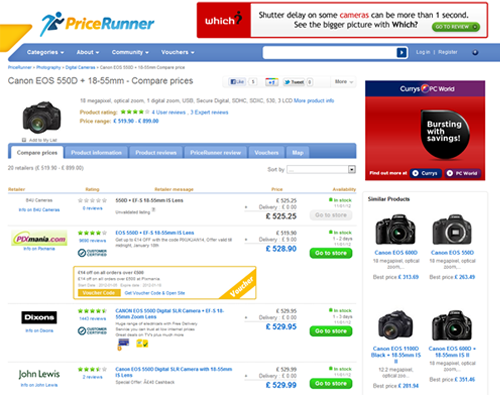
Spoiled for choice or well-informed?


Picture obtained from
http://www.pricerunner.co.uk/
 Comparison websites have great potential for the developments of online shopping: they help consumers in saving time and making informed choices. However, according to a recent BEUC position paper, for their potential to be appropriately developed, they need to be reliable. This means, that they have to be as transparent as possible as to a variety of factors, such as:
-          The ownership;
-          The way they are financed;
-          The frequency with which they are updated;
-          Their geographic coverage;
-          The methodology they employ;
-          Their coverage of the concerned sector (all providers, some providers…).
The provision of this fundamental information, in any case, should not turn into an overload for the users, thus emphasis should be put on the quality of this information, i.e. on the interest which the latter carries for consumers (the price shown, for instance, should be as “final” as possible), without  highlighting price at the expenses of other conditions which consumers should also be aware of. At the same time, the way the information is organised is important: comparability should be granted according to all relevant product characteristics, including delivery. In case of ranking, the consumer should know what factors shape it in order to assess its reliability.
Finally, supervisory authorities should take charge of monitoring comparison activities to ensure consumer trust.

Smart meters

Managing energy consumption in Europe is one of the issues that European Commission is busy with. (Cities getting smart) Since households are responsible for 40% of total energy consumption, educating consumers on smart energy consumption and changing their energy consumption habits plays a significant role in energy policy. One way to change these habits is by installing smart meters in all/most households in Europe. (Smart Grids) What are smart meters?

"Smart meters display household's energy consumption in real-time, giving users the possibility to monitor fluctuations in their energy consumption both locally and remotely – through wireless systems, the internet and smart phones." (Consumers unaware of smart meters ahead of EU-wide roll-out)

The European Commission requires the Member States to submit by 3 September 2012, their cost-benefit analysis on the deployment of smart meters. (Commission recommendation of 9 March 2012) If the analysis is positive, then the Member States should roll-out smart meters to consumers, while European Commission would set European standards on them. By 2020 at least 80% of consumers should be equipped with intelligent metering system.

At this point it seems that consumers are mostly unaware of smart meters. (Research in the UK) Representatives of consumers expressed their doubts as to the benefits of using smart meters for all consumers, since in low-income households the energy consumption is often not able to be further reduced. Therefore, the BEUC does not believe that the use of smart meters should be mandatory. (Empowering consumers through smart metering) Also the EDPS had some issues with the potential infringement of data protection regulations by the use of smart meters. (EDPS' opinion)

Wednesday, 29 August 2012

EU vs. hackers

The European Network and Information Security Agency (ENISA) published this week a report on cyber incidents reporting in the EU. Cyber security incidents often affect millions of citizens, businesses and consumers (e.g., in 2012 millions of business network passwords were exposed through hacking of LinkedIn; in 2011 due to a failure in the UK datacenter millions of users of BlackBerry across the EU and globally could not send or receive emails), but pursuant to the report these incidents are often not reported or even not detected.

Dr Marnix Dekker and Chris Karsberg, the report’s co-authors, argue: “Cyber incidents are most commonly kept secret when discovered, leaving customers and policymakers in the dark about frequency, impact and root causes.” (EU agency ENISA analyses cyber security legislation & spots implementation gaps; incidents remain undetected or not reported)

The study analyses the adopted EU measures on mandatory incident reporting from the Telecom package, e-Privacy Directive as well as the proposed e-ID regulation and the Data Protection reform, showing the differences and commonalities of their provisions and trying to create an overview of the EU cyber security strategy (see: roadmap). Areas for improvement have been identified in the paper, as well. Hopefully, new measures developed by the ENISA, like an incident reporting format will help national regulators to overcome the lack of transparency and increase the amount of information about these incidents. Harmonisaton of these issues is crucial, taking into account that often cyber security incidents taking place in one country impact citizens in other Member States.

Monday, 27 August 2012

Is living longer still worth it?

European consumers shop not only for various goods, but also for services and soon an increase of interest in purchasing new insurance policies among European women is to be expected. Why? As of 21 December 2012, on the basis of the CJEU's judgement in the case Test Achats (the Belgian Consumer Association), the insurers will no longer be able to calculate costs and benefits of insurance based on a person's gender. This gender-neutral pricing is based on the principle of equality expressed in the Gender Directive of 2004 that requires unisex pricing for European consumers. This ruling is, however, to the detriment of European women, who 'traditionally enjoyed cheaper life insurance because of their longer life expectancy'. (EU Directive Could Send Women Running to Buy Life Insurance) Some consumer organisations expect that the insurance premiums for women could rise by a third (Life insurance premiums set to soar). At the same time, certain insurance companies assure that their premiums should not be overly influenced by this ruling (e.g., http://www.aviva.co.uk/gender-neutral-pricing/). It remains to be seen whether these premiums will indeed rise and whether shopping for a cheaper insurance companies will be on many women agendas as of 2013.

Thursday, 23 August 2012

Once upon another time

Times are changing, also in the digital world. An infograph, made by Best Education Sites, gives a nice overview of the development of the Internet over the past 10 years.


Click here for the full graph. For a collection of informative pictures on a variety of topics, see also Infographic Directory.