Showing posts with label consumer information. Show all posts

Tuesday, 24 March 2026

Reconsideration or entrapment? Possible abuse of withdrawal rights under CRD, CJEU C-564/24


Over the past few days, one case has kept coming up in professional conversations which we have not covered so far - namely, Eisenberger Gerüstbau v JK (C-564/24), decided on 5 March, a new case concerning possible abuse of withdrawal rights. 

Facts and questions

In the case at hand, JK, the customer, had concluded a contract with Eisenberger Gerüstbau, a provider of scaffolding for building projects, to support the renovation/expansion works to be undertaken at a building owned by the consumer herself, for private purposes. The contract had been concluded with the assistance of an architect, who had drafted it as instructed by the consumer. The trader had signed the contract without making any changes. Signatures had been finalised in December 2020.

The scaffolding had been subsequently installed and held in place over a period of almost 12 months, during which the consumer had regularly paid a number of bills by the trader. In December 2021, when all the works for which the scaffolding had been indispensable had been concluded, the consumer indicated her wish to withdraw from the contract and demanded that all the money she had paid – close to 100 000 euros – be returned to her. The ground for her claim was that the trader had not informed her of her rights to withdraw from the contract, which would then be automatically extended from 14 days to 12 months and 14 days. The trader rejected the request and sued the consumer for the unpaid parts of the bill; the consumer counter-sued. 


The questions before the CJEU concerned two different aspects on which the referring court doubted on the way in which EU consumer law may apply to the case: first (questions1-3), whether the contract at hand (and modifications thereto) should be considered a distance contract for the purposes of article 2(7), Consumer Rights Directive, a necessary precondition for the application of the right to withdraw. Second (question 4), in case the contract had to be considered a distance contract under the relevant rules, whether in the case at hand the trader could legitimately claim that the consumer had exercised their right of withdrawal in a way that is contrary to good faith. 


The second issue was particularly laden (see para 37) as a result of a previous CJEU decision which had given pause to many practitioners, namely C-97/22. In that case, the court had upheld the right to withdrawal (and restitution of any expenses) for a consumer who had exercised their right after the contract had been fully performed. Could a different conclusion be reached in this case?


Reasoning and answers


As concerns the first question, the Court considered the three main elements that constitute the definition of “distance contract” under article 2(7) CRD, namely:” “any contract concluded between the trader and the consumer under an organised distance sales or service-provision scheme without the simultaneous physical presence of the trader and the consumer, with the exclusive use of one or more means of distance communication up to and including the time at which the contract is concluded”. One of these aspects – the exclusive use of distance means of communication - seemed to be uncontroversial. Two, however, deserved closer scrutiny. First: was the customer acting as a consumer? The referring court seems to consider that if the consumer uses the services of a professional intermediary, they may not necessarily be considered a consumer in the relationship to third party providers hired through such intermediaries. The Court’s answer to this is relatively succinct, in so far as it concludes, relying on the AG’s opinion, that “a consumer was assisted by a trader, in the present case an architect, in the context of the negotiation and conclusion of a contract between that consumer and another trader, is not such as to call into question the weaker position […] of that consumer vis-à-vis that other trader, even though the trader who assisted that consumer took the initiative to establish the contact between that consumer and the other trader and influenced the content of that contract”. This may be a dubious reasoning as no effort is made to show why the use of a professional intermediary should not affect the presumption that a consumer “must be deemed to be less informed, economically weaker and legally less experienced” [para 44] than their counterparty. 


Perhaps unexpectedly, the CJEU has more doubts as to whether the contract in question should be considered as concluded “under an organised distance sales or service-provision scheme”. From the description of the negotiation, it is clear that the contract was concluded exclusively by means of distance communication, but not that the trader themselves had set out any “organised” scheme for such distance negotiations. In that sense, the CJEU concluded that it is up to the national court to decide whether the contract was a distance contract under article 2(7) of the CRD. 


The answers to the previous questions made it still meaningful to answer the question concerning whether the consumer could be considered to be exercising their right of withdrawal against good faith. In this sense, the Court reaches to its own case-law on the notion of “abuse of right”, which is known to be very demanding and as such helps the CJEU distinguish this case from the one decided in C-97/22. The Court first observes that it has in the past held that “the application of eU legislation cannot be extended to cover transactions carried out for the purpose of fraudulently oer wrongfully obtaining advantages provided for by EU law”. This is the case when it can be shown that first, “despite formal observance of the conditions laid out by the EU rules, the purpose of those rules has not been achieved”, and, additionally, “a subjective element consisting in the intention to obtain an advantage from those rules by artificially creating the conditions laid down” for obtaining that advantage. The Court refers here to its own Grand Chamber judgment of 21 December 2023, BMW Bank and Others (C-38/21, C-47/21 and C-232/21, paragraph 285), which concerned potentially abusive exercise of the “eternal” right of withdrawal in consumer credit agreements. 


The threshold imposed by these requirements is, in essence, high enough that it could overcome not only the general demands of a high level of consumer protection but also the punitive elements inherent in the specific rules at hand, which extend the right of withdrawal by 12 months when consumers have not been informed of this specific right. 


In this sense, the Court reasons, it is not enough to observe that a consumer has exercised their right of withdrawal towards the end of the extended withdrawal period. However, additional facts specific to this case may be relevant; in particular, the referring court may consider the fact that the contract was “concluded on the basis of a draft prepared under the sole responsibility of the consumer by an agent of her choice, in accordance with the information given by the latter as regards the precise services expected from the trader, which that trader then signed without making any amendments”[para 78]. This could suggest that the objective element of the abuse test – formal observance of the rules undermining the objective of those same rules – may be met. 


The circumstances of the case, the CJEU concludes, may further suggest that the subjective element of the test has also been met – the timing of the invocation of the RoW, right between the conclusion of the necessary parts of the work and the expiry of the 12-month window to exercise her right of withdrawal constituting a potentially relevant factor.


Some preliminary thoughts


The second question/answer discussed above is the main reason why the judgment has drawn some attention within legal circles. While similar implications could be drawn from the 2023 car lease cases, those cases were so steeped in a specific discussion and litigation saga that it was not immediately clear how broadly the CJEU may be willing to generalise the applicability of the abuse doctrine in consumer law. This case, of course, doesn’t answer this question either, being ultimately still about withdrawal rights. It does, however, help us make some tentative distinctions. First, abuse of withdrawal rights is more than the somewhat disproportionate exercise of said rights. It requires an ex ante dimension of creating a situation which gives rise to potential legal consequences, and at least explicit awareness of this dimension. This means, second, that the “windfall” a consumer enjoys when profiting from a trader’s mistake is not equivalent to abuse. This makes sense, in particular, in light of the Court’s consistent position that such consequences are both meant to provide consumers effective remedies and sanction the traders for non-compliance, thereby incentivising compliance. 


The previous question may get less attention, but I do want to reflect on two aspects that I find notable: first, I mentioned above that the reasoning with which the Court denies that the presence of an intermediary may mean the customer may not quality  as consumer under (in particular) the CRD does not sound particularly convincing. If we go with the Court’s own recalling that consumers must be assumed to be weaker in terms of knowledge, financial means and and legal savvy, it seems that – contrary to what the Court claims – the presence of a professional intermediary would by definition intervene to mitigate some of these asymmetries. An intermediary will likely be hired precisely to provide additional knowledge and (contract-specific) legal experience, and their involvement may even mean that the consumer has sufficient investment in the contract that they may be financially almost comparable to an entrepreneur. At the same time, while the reasoning may be weak (pun not too intended), it seems wise of the Court not to open up to broader questions about when the presence of an intermediary may matter to someone’s consumer capacity. This seems like a question that, if at all, should be properly addressed by legislatively set exceptions. The case-by-case appreciation of the role of the intermediary finds a more limited, and hence arguable more appropriate, role in the assessment of the potential abuse. Second, I find it interesting that the Court proposes a rather strict interpretation of the “organised scheme” element in the definition of a distance contract, suggesting that situations in which the trader does not systematically work online/through means of distance communication may not be automatically drawn under the application of the more demanding CRD requirements for distance contract by the mere conclusion of the contract by means of distance communication. 

Monday, 15 December 2025

Labeling strikes again: non-alcoholic drinks cannot use the name "gin" (CJEU C-563/24 | PB Vi Goods)

It's been almost exactly one month since the CJEU issued a judgment which has left many non-lawyers (and also some lawyers) quite puzzled. The judgment may not concern consumer law strictly speaking, but will be of certain interest to those interested in consumer law and policy - and even more so with the holidays approaching. 


In PB VI Goods, the Court has sided with a German association in maintaining that PB VI Goods could not sell a beverage under the name "Virgin Alkoholfrei Gin". 

The decision is based on Regulation EU 2019/787, which concerns the "definition, description, presentation" and labelling of "spirits", including gin. The Regulation's stated aims include consumer protection, market transparency and fair competition, as well as the safeguarding of the Union's traditions and reputation in the field of spirits. This includes the protection of certain geographic designations  All three variants of Gin mentioned in the Regulation (Gin, Distilled gin and London Gin) have a minimum alcohol content of 37,5% and have to fulfil with other requirements concerning production process and allowed ingredients. 

Based on these facts, it is not too surprising that the CJEU declared that labelling a drink as "alcohol free Gin" goes against the Regulation: if that would be allowed, it would e.g. not be clear why a "reduced alcohol Gin" would have to be treated differently, whereas it is the Regulation's specific goal to prevent any variations other than those in line with the original designation to use the regulated denominations - not only in order to protect consumers against confusing terminology, but also to protect producers against exploitation of their reputation by competitors who are not bound by the same production standards. 

The Court also refers to its previous - and equally strict - decision in C-422/16, Tofutown.com, which similarly decided that plant-based drinks could not use the term "milk", even if indicating clearly in their name their non-dairy nature. The only allowed exceptions in that case were those made already within the relevant European rules, e.g. for products traditionally named as "milk" in some countries. 

PB VI's claim that the rules concerning spirits denominations may be against article 16 CFREU (freedom to conduct a business) were dismissed by the CJEU after a short analysis on the basis of the principle of proportionality. The restrictions were found to be appropriate to pursue legitimate aims (those discussed above) and not excessive, in particular due to the fact that they do not affect the ability to produce and market the concerned beverages, but only to call them "gin". For advocates of consumer choice and conscious lifestyles, the Court's argument that the designation may be misleading because of the role that "flavouring ethyl alcohol of agricultural origin with juniper berries" (and not, thus, water) plays in the production of Gin may sound formalistic and inconsequential - as consumers looking to replace alcoholic beverages with alcohol-free variants will likely be aware of the meaning conveyed by the terminology. 

At the same time, the literal meaning and spirit of the rules are quite unambiguous and the operation here consisten – regulated denominations are strictly enforced. Furthermore, there is no sense that a different approach could have plausibly anticipated on future developments as the European Parliament has just signalled a wish for stricter protectionof “traditional” food denominations, which would ban the use of “meat-related” names for non-meat products (think of “plant-based burgers” and similar terms). BEUC was among the first to point out that most consumers feel absolutely not confused by the practice, as well as to argue that the association is actually necessary/hepful for food replacements to find their audiences and play their role in the protein transition. 

Similarly, it seems that the rule concerning alcoholic beverages is likely to play out quite differently for different producers, favouring incumbents - whereas, for instance, an established gin producer will easily be able to leverage their brand recognition to also market their non-alcoholic product lines (imagine something like "Gordon's dry alcohol free"?), newcomers who want to focus on non-alcoholic drinks will not be able to signal their niche to customers will find it much more difficult to do so. 

We will keep an eye out for further developments!

Thursday, 20 March 2025

"Young promise" or just a consumer? CJEU in C-365/23 [Arce]

Today the Court of Justice has delivered a truly remarkable judgment that I am eager to share with readers of this blog (available here, even though for now only in French and Latvian). The decision concerned a contract concluded between "A", a professional in the business of offering career development services for sports talents, and "C", then 17 and represented by his parents to the ends of concluding the contract. 

According to the contract, concluded on 14 January 2009 for a period of fifteen (15) years, A would offer a wide range of services in support of C's development as - hopefully, professional - basketball player. In return, C would pay A 10% of all the net revenue he was to earn for the duration of the contract, plus VAT, as long as such income would pass the threshold of 1500 euros per month. 

A bit over a decade into the contract, A sued C for failing to fulfil their obligations under the contract, with a claim amounting to over 1,6 million euro - 10% of what the player had earned from sport clubs until that point in time. [We are not sure how this was calculated, but A would likely know since accounting services were included in the contract]

Latvian tribunals, which were competent to adjudicate on the dispute, were not keen to grant A's claim: the demand was rejected in first and second instance on ground that the term was unfair under Latvian consumer law; A took the case to the Latvian Supreme Court, which in turn raised *twelve* preliminary questions for the CJEU. Luckily, not all questions have to be answered and not were equally challenging, so the analysis here will be limited to the most salient points. All have to be seen to pertain to the Unfair Terms Directive - from the definition of consumer under that directive to the scope of minimum harmonisation. 

Consumer contract?

First: was the "career development services" contract a consumer contract? The referring court noticed (see para 31) that across different jurisdictions different stances were noticeable concerning similar cases, with a court in France having concluded that a young talent concluding a comparable contract had to be considered a consumer, while an earlier German case has excluded the applicability of consumer law to the type of services at hand. 

The Court of Justice answered that, to the extent that the minor at hand was not a professional player at the time of concluding the contract, they should be considered consumers - and hence enjoy consumer protection. The fact that the player later engaged in professional sports does not change this conclusion as the party's quality as consumer must be, for the purposes of unfair terms rules, ascertained only with reference to the moment that the contract was concluded. The fact that the contract concerned the player's "eventual professional career" doesn't change this conclusion either. 

While the Court recalls its previous decision in Costea, other decisions concerning the notion of consumer when "bordering" professional activities, such as Gruber, were not discussed. This means, however, that it is difficult to immediately assess the reach of the judgment: will this "generous" take also cover adults who engage comparable services in the hope to undertake a professional activity that they have not engaged in yet, or is this interpretation limited to the case of minors who have not engaged yet in the relevant professional activity? AG Rantos' reasoning in his opinion, as reported on in Joasia Luzak's overview of last month, seems to suggest a broad applicability (which may go against the common assumptions in several member states!).

"Price" term exempted from control?

Having established that the Directive was applicable to the contract under consideration, the CJEU had to consider whether the term was actually subject to the unfairness test. This was contentious since article 4(2) of the Directive famously dictates that the test shall not concern "the definition of the main subject matter of the contract nor to the adequacy of the price and remuneration". A claimed that the term should then not be subject to judicial control. The CJEU agreed as to the applicability of the exception - in line with the second part of article 4(2) then, the national courts would only be able to assess the term's unfairness if the term did not comply with the requirement of transparency - being "in clear and intelligible language". 

In this respect, the CJEU seemed to suggest that the term may not comply with the transparency requirement: it is however for the national court to ascertain whether the term was sufficiently clear that the consumer could understand its impact on their legal and economic position. In this respect, the Court considers that both the information provided to the consumer (and their representatives!) at the time of concluding the contract and, interestingly, the term spelling out what services A would provide against the agreed remuneration should be seen as relevant to the assessment. Furthermore, since Latvia had not yet explicitly implemented the exemption of article 4(2) by January 2009, it is possible that on the basis of minimum harmonisation the term would still be open to scrutiny even if transparent. The Court then proceeds to answer questions that would be relevant in case the term can be subject to control. 

Is the term unfair? 

As we know, it is for national courts to decide whether a specific term is unfair; the CJEU, however, can provide parameters to support the national courts, which they have done in a number of cases. In this specific case, the Court adopts a reasoning which is in some way new - at least to the extent that it seems to establish a hierarchy or order of reasoning between the two prongs of the unfairness test - that the term causes a significant imbalance contrary to good faith. While these two elements (good faith and significant imbalance) are often considered as hardly distinguishable, the Court here suggests that one should "at first" consider the possible violation of the principle of good faith, and "second" ascertain the eventual existence of a significant imbalance. This is not unheard of, as the references in the decisions show, but it is usually not regarded as more than a style clause. 

In assessing whether the term is unfair, thus, the CJEU asserts, the national court should consider on the one hand whether the professional, dealing in honest and reasonable way, could expect the consumer to accept the term in individual negotiations, while on the other hand considering national default rules to ascertain whether the clause created a significant imbalance in the rights and obligations of the parties (compared to their rights in case nothing had been agreed). In doing so, and this is genuinely new, it can consider "fair market practices" around the pricing of similar services at the time of the contract's conclusion, or "the obligations that a reasonably informed consumer could expect to incur" (see para 84). The Court takes these additional criteria from the AG's opinion and it will be interesting so see whether this reference to market practices will prove to be incidental (it is after all a rather niche subject!) or take hold. 

Fundamental rights?

Finally, the Latvian Supreme Court wanted to know whether fundamental rights should be considered in assessing the term - in particular the right to property (art 17 EUCFR) and the requirement for public authorities and private entities to pay the highest attention to the "best interest of the child" when taking decisions concerning minors (art 24 EUCFR). In this sense, the CJEU first observes that the Charter is applicable (see para 99) to the questions at issue since they fall within the MS's implementation of EU law (on this, the Court has been holding that this applicability is in no way affected by minimum harmonisation, which we won't be again questioning now). Setting aside with no further ado the relevance of article 17, the Court focusses on article 24: indeed, national courts should take it into account when making decisions concerning the unfairness of terms included in contracts concluded by (at the time of conclusion) minors. This is in line with fairly established idea on the indirect horizontal application of fundamental rights. At the same time, the CJEU seems cautious to avoid over-protective applications: consideration of the best interest of the child, the Court explain, does not exclude that the national court could consider the fact that the parents, concluding the contract on the child's behalf, were familiar with the environment of professional sports, or the fact that C was already 17 at the moment of concluding the contract (see para 103). 

Hence to conclude: C was a consumer; the clause is in principle exempted but may be open to control either because lacking transparency or because Latvian law did not incorporate the exemption at the time the contract was concluded; if the national court does assess the clause, they should consider national default rules, good market practices of the time as well as the best interest of the child, but also consider that supposedly competent parents acted as representatives. Also, not discussed here because not at all surprising, if the term would be found unfair the national court would not be able to proceed to mitigation of the due sum - which opens to the usual drama around consequences since the contract would then likely be invalid. 

What will happen once the case is back with the Latvian courts then? Readers who have access to Latvian sources - do reach out to let me know! This case has all the ingredients of an instant classic.

Saturday, 15 March 2025

Information duties in consumer credit: the CJEU in C-677/23

At the end of January, the CJEU delivered another judgment interpreting Directive 2008/48 on Consumer Credit. In C-677/23 A. B., F. B. v Slovenská sporitel’ňa a.s. consumers alleged that the credit contract did not contain all the necessary elements provided by the Directive. The dispute thus involved the interpretation of Article 10 (2), which provided the mandatory content for the credit contract. Two subparagraphs came under scrutiny in this case.


Duration of the credit agreement


One problem was that the credit contract did not provide for its entire duration. However, it did lay out the number of instalments to be paid. Under Article 10(2)(c), the credit agreement shall specify clearly and concisely the duration of the credit agreement. The question for the CJEU, therefore, was whether it is sufficient to comply with this provision by indicating the number of instalments. 


The CJEU concluded that since the duration of a credit agreement is closely linked to the performance of the parties' contractual obligations “the indication of the duration of the credit agreement, in accordance with Article 10(2)(c) of Directive 2008/48, does not necessarily have to be made through a formal indication of the precise date on which that agreement begins and ends, provided that its terms enable the consumer to determine that duration without difficulty and with certainty” (para. 43).


Assumptions used in the calculation of the APRC


The second question considered by the CJEU was about interpretation of Article 10(2)(g) according to which the credit agreement shall specify in a clear and concise manner “the [APRC] and the total amount payable by the consumer, calculated at the time the credit agreement is concluded; all the assumptions used to calculate that rate shall be mentioned." The wording in the contract was the following: "The credit has been granted immediately, in full; the borrower shall fulfil his or her obligations under the terms and conditions and within the time limits set out in the credit agreement; the interest rate shall apply until the end of the credit relationship". Another part of the contract provided that “the agreement shall be concluded for a … fixed period until the full settlement of all relationships arising in connection with the credit granted". The consumers considered these unclear. 


The CJEU considered the purpose of the provision and asserted that it is aimed at making the consumers aware of their rights and duties (para. 58). Moreover, reference to the assumptions must enable consumers to verify whether the APRC has been calculated correctly and, if not, to assert their rights, particularly the right of withdrawal, the period of which is extended in case of breach of Article 10 (para 59). Reference to the assumptions should also enable consumers to exercise their other rights provided by national legislation, including sanctions for non-compliance, which in this case, under the applicable Slovakian law, meant that the credit is interest-free (para 59). 


The CJEU concluded that assumptions used for the calculation of APRC are "vitally important" for consumers (para. 61), which meant that the "the assumptions used to calculate the APRC must be expressly mentioned in the credit agreement and that it is not sufficient in that regard that the consumer may himself or herself identify them by examining the terms of that agreement" (para. 64).


Concluding thoughts 


This judgment reinforced the importance of consumer information for the enforcement of consumer rights. Whilst it is questionable to what extent assumptions in the calculation of APRC are understandable for individual average consumers with no legal and financial background even if they are expressed in clear and precise language, the CJEU rightly held that if information is scattered around the contract and not expressed clearly and straightforwardly it is even more difficult to consumers to comprehend the effect and consequence of the terms of their contract. This judgment is, therefore, a further push towards clearly structured and worded contracts that at least give consumers a chance to understand their rights and duties and enforce their rights accordingly.


The judgment continues to be relevant under the new Directive 2023/2225 on Consumer Credit, which contains the scrutinised provisions in Article 21(1)(d) and (g).

Tuesday, 2 April 2024

Vouchers, an acceptable reimbursement? - CJEU in C-76/23 (Cobult)

On March 21, the CJEU published the most recent judgment interpreting provisions of Regulation 261/2004 on air passenger rights in the case Cobult (C-76/23) concerning the possibility of reimbursing passenger's ticket cost through a voucher.

By Lu Lettering from Pixabay  
Many of our readers may have experienced a flight cancellation over the past couple of years, not limited to Covid-19-related causes. In case of a cancellation passengers may choose to have their cancelled flight rescheduled (re-routing) or have their ticket costs reimbursed, pursuant to Article 8 of the Regulation 261/2004. Reimbursement could happen via various means, including via a voucher but the latter only upon passenger's "signed agreement", pursuant to Article 7(3). Thus the reimbursement by a travel voucher "is presented as a subsidiary means of reimbursement" (para 20). 

In this case, TAP Air Portugal invited passengers to fill an online form to claim reimbursement of ticket costs, which would lead to them being immediately compensated in travel vouchers. The online form included conditions of acceptance, with text clarifying that acceptance of a travel voucher precluded further reimbursement claims in other forms. An alternative way of reimbursement was available, if passengers contacted their customer service department and allowed them to examine case facts (paras 8-9). 

The CJEU does not exclude a possibility that passengers could have provided a 'signed agreement' in an online reimbursement form. A 'signed' agreement does not need to include the consumer's signature on an online form they are submitting to the air carrier for reimbursement (para 34). However, certain conditions would need to be met. First, passengers need to be able to give their free and informed consent to reimbursement via a travel voucher (para 22). This will require air carriers to provide passengers with "clear and full information on the various means of reimbursement" of ticket costs (para 30). This condition will not be fulfilled if e.g., air carrier (para 32):

  • leaves any ambiguity on its website, 
  • presents partial information, 
  • writes information in a language that passengers may not be proficient in (e.g. information in this case was given only in English - would this be seen as compliant if many passengers were Portuguese-speaking?), or 
  • if the procedure for claiming monetary payment is unfair if compared to the procedure of claiming travel vouchers e.g. because it contains additional steps.

"(...) the addition of such supplementary steps is liable to render reimbursement by a sum of money more difficult to obtain, and thus to upset the relationship between the two means of reimbursement" (para 33) - this is an interesting conclusion by the CJEU, which follows recent developments in other areas of EU consumer law. For example, when assessing fairness of cancellation process of online subscriptions, we would also check whether there were additional steps included, which made the process more complex than when subscription was concluded.

Wednesday, 6 December 2023

Revision of EU travel rules

By Alex Azabache on Unsplash
Last week, on November 29th, the European Commission announced the forthcoming (long-awaited) revision of EU travel rules (Improved rights and better information for travellers). This concerns a few legislative measures: 

1. Revision of Regulation 261/2004 on Passenger Rights through a newly proposed Regulation as regards enforcement of passenger rights in the Union

  • new rules for passengers who booked flights via an intermediary
    • an intermediary being defined as any ticket vendor, organiser or retailer other than a carrier
    • new Article 8a adds a reimbursement right 
      • passengers will need to be clearly informed by the intermediary and air carrier about the reimbursement process
      • free of charge
      • if reimbursement occurs through intermediaries: Air carriers shall reimburse intermediaries within 7 days, with intermediaries reimbursing passengers within further 7 days
      • if passengers do not receive reimbursement within 14 days of choosing for this remedy, the air carrier contacts passengers to receive payment details and reimburses them within further 7 days
    • new Article 14a adds rules on the transfer of passenger information, its safeguarding and when to delete it
      • this will facilitate intermediaries sharing passenger information with air carriers, so that air carriers can be in contact with passengers about their flights
  • strengthening enforcement mechanisms (similar mechanisms have been proposed to be added also to Regulation 1107/2006, Regulation 1177/2010, Regulation 181/2011, and Regulation 2021/782)
    • new Article 15a requires air carriers to establish 'service quality standards' (Annex II contains a minimum list thereof) and implement 'a quality management system'
    • new Article 16a specifies that the Commission will adopt a common form for reimbursement and compensation requests under Articles 7 and 8 Regulation 261/2004
      • passengers will retain the right to submit their refund requests by other means
      • passengers shall be free to provide information in any of the EU languages
    • new Article 16b specifies that national enforcement bodies should adopt a risk-based approach to monitoring compliance with passenger rights
      • this should allow detection and correction of 'recurrent non-compliance'
    • new Article 16bb determines that carriers shall share information with national enforcement bodies within 1 month from the request (max 3 months in complex cases)
    • new Article 16bc requires informing consumers about ADR

2. Revision of Regulation 1107/2006 on Rights of Disabled Persons and Persons with Reduced Mobility when Travelling by Air through a newly proposed Regulation as regards enforcement of passenger rights in the Union

  • special right to assistance for persons with reduced mobility 
    • including right for free of charge travel for a companion (if necessary to comply with safety procedures) - in Article 4(2)

3. New proposal for a Regulation on passenger rights in the context of multimodal journey

  • multimodal journey is defined as a 'journey of a passenger between a point of departure and a final destination covering at least two transport services and at least two modes of transport' (Art 3(1))
  • whilst the new provisions will apply to various types of multimodal journeys (single contract, combined contract, separate tickets) the unifying link between them (and limitation to scope) is that all transport contracts need to be offered by a carrier or intermediary
    • whether payment takes place together for all services or separate is irrelevant though
    • still, this means that the Regulation will not apply when it is the traveller who seeks out various connection between travel modes on their own
  • Art. 4 - establishes the right to non-discriminatory contract conditions and tariffs
    • discrimination is not allowed on the basis of passenger's nationality or the place of establishment of the carrier or intermediary
  • Art. 5 - better information for passengers combining different travel modes (air, rail, road) in one trip
    • e.g. on minimum connecting times between different transport modes, time schedules and conditions for the fastest trip, highlighting the lowest fares, disruptions and delays, complaint procedures
    • intermediary transfers passenger data to all carriers involved to facilitate direct communication between them
    • caveat: SMEs are exempted from having to provide real-time information
  • right to assistance in case of missed connections
    • Art. 7 - right to reimbursement and re-routing
      • re-routing with the same (or another commissioned) carrier should not bring with it additional costs to passengers
      • reasonable efforts should be made to ensure short delays in total travel time and to avoid additional connections
      • reimbursement should be paid within 14 days (and may include vouchers, provided passengers agree to this)
    • Art. 8 - reimbursement through intermediaries
      • provided carriers agree, travellers could request reimbursement from intermediaries
      • carriers then reimburse intermediaries within 7 days, and intermediaries have further 7 days to reimburse passengers
      • if passengers do not receive reimbursement within 14 days of choosing for this remedy, the carrier contacts passengers to receive payment details and reimburses them within 14 days
    • Art. 9 - right to assistance
      • free of charge
      • means and refreshments - reasonable to waiting time
      • accommodation (and transport to it) - up to 3 nights
    • Art. 10 - liability for combined multimodal tickets (with a single point of payment for all services) in case of missed connections
      • carrier/intermediary liable to reimburse total amount paid for combined multimodal ticket + compensation (75% of the total ticket price) 
      • unless clear information that the combined multimodal ticket consists of separate transport contracts
    • Art. 11 - common form for reimbursement and compensation requests
  • Chapter IV - contains rights for passengers with reduced mobility
  • Chapter V - contains provisions on assuring quality of services
  • Chapter VI - information and enforcement provisions

3. Revision of Package Travel Directive (2015/2302)

  • Package organisers granted a right to a refund from service providers in case of cancellation or non-provision of a service within 7 days (Art. 22)
    • to facilitate reimbursement of travellers within 14 days
  • Downpayments for packages limited (new Article 5a)
    • to max 25% of the package price, unless higher downpayment is justified by package organisers having to pay upfront for service provision
    • total payment should not be requested until 28 days before the start of the package
    • this is to protect consumers against risk of bankruptcy of organisers
  • Revised Art. 12 clarifies termination rights in case of extraordinary circumstances (such as Covid-19)
    • e.g. the need to consider official warnings against travel, but also serious restrictions that would have applied to travellers' travel at destination or upon return from travel at home country - when looking for justified termination
  • New Art. 12a clarified vouchers policies 
    • travellers transparently informed on the right to insist on a refund and voucher characteristics (validity period)
    • voucher's amount should at least equal the amount of the refund right
    • vouchers shall be valid min 12 months from the day travellers' accept them (with an option to extend by 12 months - once)
    • refunded automatically (within 14 days) if not used before the end of the validity period
    • vouchers shall be transferable to another traveller without any additional cost
    • vouchers and refund rights covered by insolvency protection

Additional proposals have been adopted that aim to facilitate better provision of information to travellers on available travel modes, incl. combining different types of travel (revision of Delegated Regulation 2017/1926 on the provision of EU-wide multimodial travel information services). This new service intends to provide real-time information and updates, also on delays and cancellations, as well as specific information, e.g. on possibilities of taking bikes on a train (see more here).

Friday, 15 September 2023

Ex officio and package holidays - CJEU in RTG v Tuk Tuk travel SL (C-83/22)

 Dear readers,

do you remember when the Package Travel Directive (2015/2302) and package travel rules all of a sudden seemed very current, back at the heights of the pandemic, after having been mocked for years as the 2015 rules for 1980s holiday-making? Well, in a reminder that we all sit in our little bubbles :), it turns out consumers may not have noticed all the fuss in the legal community after all - but ex officio is there to make courts watch. 

Here's the story: yesterday the CJEU published its decision in RTG v TUK travel SL, which concerned a refund claim by a consumer who had planned and cancelled a trip to a faraway location in 2020. When trying to get his money back, the consumer was informed by the travel organiser that they would only be able to recover a very tiny sum. Subsequently, he sued for recovery claiming the contract was terminated due to force majeure, demanding ca 75% of the original sum - in acknowledgement of what the consumer thought were reasonable expenses incurred by the organiser. 

The national court seised with the case had its quandaries with the claim: on the one hand, the judge knew that the Package Travel Directive's article 12(2) entitled the consumer to a full reimbursement in cases like the one at hand; on the other hand, rules of Spanish civil procedure did not allow the court to modify the consumer's claim. The Court asked the parties to clarify - had the trader in fact informed the consumer, at the moment of concluding the contract, that he had a right to termination without consequences if the trip had to be cancelled? Apparently they had not. 

I will not discuss here the first question asked by the court, which rested on a misunderstanding of the text of the directive. The second question, however, in essence asked - to what extent are courts required to apply the Package Travel Directive ex officio? 

The CJEU gave a reasonably helpful answer to this question. In essence, national courts in similar situations will have to ex officio examine whether the rules in the Directive have been complied with, on the basis of the information available within the procedure. If the Court ascertains a violation - like, in this case, of article 12(2) - it will allow the consumer to amend their claim. Courts are not required or allowed, however, to go on and apply the remedy ex officio "rewriting" the consumer's claim without further ado. 

This is a somewhat systematically ambitious judgement to the extent that the CJEU (para 54-57) ventures into expressly translating previous case-law into a series of requirements without which ex officio cannot take place:

  • the court must have a judgment pending about the specific contract at hand brought by one of the parties
  • the involved provision (right to terminate) must be relevant to the object of the dispute as identified by the parties
  • the court must have all the necessary elements available and
  • the consumer must not have expressly objected to the application of the provision at hand. 

The first three requirements appear taken almost verbatim from the CJEU's previous decision in Lintner (C-511/17 - see our comment here), concerning unfair terms; the last one also seems to reflect case-law in the same area, and namely Dziubak (C-260/18 - see our comment here). 

Different to many ex officio cases, this case did not concern an absentee consumer - only one who had gone to court without a lawyer and maybe therefore (and because of the trader's failure to comply with consumer protection law) had not formulated their best possible claim. Also contrary to Duarte Hueros (C-32/12 - see our comment here), this consumer had in fact formulated a successful claim - but one that was not as advantageous as the one that he was allowed under consumer law. In this respect the decision is both far-reaching - it's not obvious that the consumer would have not received effective protection without ex officio, so the "public order" reason for control seems to feature prominently - and rather modest in not prescribing an outcome (which seems to make it less of a public order reasoning). In any case, this being Friday afternoon, I will say that it's not particularly easy to feel in this case for the trader who had actively tried to mislead the consumer as to his rights. Not nice of you, Tuk Tuk travel!

Tuesday, 26 April 2022

New clarifications on information rules in the Consumer Credit Directive: the CJEU in Volkswagen Bank

In September 2021 the CJEU delivered an important judgment on the interpretation of the creditor's duty to inform and the associated consumer's right of withdrawal in Directive 2008/48/EC. Unfortunately, the judgment took a while to be published in English, and therefore we only managed to create this note now. The judgment remains relevant, also in light of the new Proposal (on which we reported here), which contains equivalent provisions in Articles 21 and 26.

The judgment concerned C-33/20, C-155/20, and C-187/20 joined cases involving consumer credit and further shaped the content and application of Article 10(2) and Article 14(1) of the Directive.

In terms of Article 10, the judgment is fairly technical with answering very specific questions on the content of the credit agreement, adding to the already detailed content of Article 10. The CJEU in this judgment specifies for instance that the contract must state clearly that it is concluded for a fixed term and that the contract does not need to set out all the situations provided by national law in which the contracting parties can terminate the contract. Particularly interesting are two interpretations provided by the CJEU:

On Article 10(1)(l) under which credit agreements must state in a clear and concise way the applicable rate of late payment interest at the time of contract conclusion, the arrangements for adjusting the rate, and any charges payable at default, the question was, in what way should the rate of interest be indicated. In the issue at hand, the contract said that the rate of interest will be 'five percentage points above the relevant base rate'. While the relevant base rate is fairly easy to determine, the CJEU did not agree with this formulation, they reasoned that this is the formula provided for calculating the rate of interest. In order to fully inform consumers, the contract must state the rate of interest in a specific percentage, similar to how the borrowing rate and the annual percentage rate of charge must be presented. In addition to expressing the late payment interest in a percentage then, the contract must also specify the way in which this rate is adjusted, enabling an average, reasonably observant, and circumspect consumers to determine and understand the arrangements for varying the late payment interest. In order to achieve this, two conditions must be satisfied: first, the method of calculation must be set out in a way that is readily understood by an average consumer who does not have specialist knowledge in finance and which enables the average consumer to calculate the rate of late payment interest based on the information provided in the contract; second, although the CJEU seems to be of the opinion that a national base rate is a good benchmark, this is only so, if the contract set out the frequency with which the base rate may be varied, as determined by national provisions.

Another interesting aspect of the judgment was the CJEU developing interpretation of Article 14 on the right of withdrawal. The CJEU ruled that if the information is not dully included in the contract following Article 10 and was neither communicated at a later stage, there is no time limit for the consumer to exercise the right of withdrawal under the Directive nor can the Member States impose such limitation in national legislation. The CJEU's standpoint was that in that case, the consumer was unaware of the limitation of the right, and the consumer could not be held responsible for that lack of awareness. This is true even if the right of withdrawal was exercised following a considerably long period after the conclusion of the contract; the CJEU dismissed the possibility of the consumer being held liable for the abuse of this right under the circumstances.

Wednesday, 13 April 2022

A promise is a promise - or is it? Ask the average consumer! CJEU in C‑249/21, Fuhrmann

 We've all been there - trying to decide whether to go for the hotel which promises nicer breakfast or the one with free cancellation until 24 hours before arrival. We don't know what happened to mr B, who booked an expensive hotel in a German village and didn't show up to take possession of his room(s). We do know, however, that he did not cancel his reservation in time - after which he was confronted with a hefty bill for a five-night stay he had reserved and made no use of. This led to an interesting decision by the CJEU last week, in case C-249/21.

The hotel reservation in this case took place via booking.com, which displays a final button: "complete booking" once a user has filled in all necessary identifiers. Does this mean that once they have clicked the button, a consumer has in fact entered a contract with the facility they selected?

According to the national court that referred this case to the CJEU, the dispute depends on whether the words ‘complete booking’ (in the German original: Buchung abschließen), satisfies the obligation laid down in Paragraph 312j(3) of the BGB, which requires the trader to display in an easily legible manner on the button for placing orders the words ‘order with obligation to pay’ or a corresponding unambiguous formulation. This provision implements the information obligations established by the second subparagraph of Article 8(2) of Directive 2011/83; the next section, namely Paragraph 312j(4) of the BGB, provides that a contract is then concluded if the information/warning was correctly provided. 

 Is "complete booking", in other words, a sufficient clue that a contract is about to be concluded, or should more explicit language be adopted given the fact that "booking" in everyday language can easily refer to a non-committal form of reservation with no contract being concluded?

The CJEU recalls that the Consumer Rights Directive must be interpreted with an eye to the achiement of a high level of consumer protection; in this spirit, however, any formulation that will deliver the essential notice to the consumer will be apt to comply with the Directive's requirement: while the Directive itself mentions "order with an obligation to pay" as an example of wording that can convey the necessary message, according to the court this does not mean that service providers have to reproduce the exact same wording (para 26-27). However, according to the Court it is also clear from the wording of the Directive that the button itself must display sufficiently unambiguous language - the context alone, or previous stages in the interaction between consumer and trader, cannot make good for insufficiently clear communication at the late stage since the Directive's article 8 refers to information to be explicitly provided just before the contract is finalised (para 28-29, with reference to recitals).  

In conclusion, thus, it is for the referring court to ascertain whether, in the day-to-day use of the German language, "Buchung abschließen" can be considered to carry an unambiguous meaning which is tantamount to "order with an obligation to pay". In doing so, the court will have to keep in mind the "average consumer who is reasonably well informed and reasonably observant and circumspect".  

A number of elements are remarkable or interesting in this case: first, the demanding interpretation of article 8(2), excluding that the context of the transaction would be enough to expect the consumer to understand a certain click as entailing an obligation to pay; second, the fact that booking.com likely uses very similar language across its language versions, but will now probably have to initiate an investigation into the overall implications of all those versions (or change the button to add a reminder that confirming means entering an obligation to pay, which would probably - without really changing the legal reality in most Member States, scare off a certain quota of consumers); third, it reminds us of the importance of different implementation techniques, as it was Germany's specific choice to connect the contract's conclusion to the compliance with information obligations in cases like this one; finally, and perhaps most startingly, the case reminds us of the platform paradox. While booking.com had been the one setting up the context of the transaction as well as the concrete looks and language of the confirm button, the company stays entirely out of the underlying litigation: if their button, in other words, would be found ambiguous, other service providers (ie the hotels) would possibly be in trouble.  Neither does it seem to me - but it may be due to my poor reading - that article 4 in the modernisation directive, amending the CRD to add specific information obligations on the side of platforms, would change this conclusion. LMK via available channels if you have any thoughts on this!

Monday, 11 April 2022

Proposal on Empowering Consumers for the Green Transition/Part 2

 Last week, I posted a summary of the main changes the Proposed directive for empowering consumers for the green transition would bring to the Unfair Commercial Practices Directive. Today's second part will be devoted to the Consumer Rights Directive. 

Next to preventing "greenwashing" and unsubstantiated claims, the Commission aims that consumers get the right information, that is information that allows to make them more sustainable choices - in particular choosing for more energy efficient, durable and reparable products. 

Six items are added to the pre-contractual information requirements, both for distance and off-premises contracts and for other transactions coming under the scope of the Directive. 

These six additional items concern guarantees, updates and repairs (including some complicated language about telling consumers what they have not received information on).  

information on the existence and lengthof a producer’s commercial guarantee of durability for all types of goods, when this information is made available by the producer; 

information that no information has been provided by the producer about the existence of a producer’s guarantee of durability for energy-using goods;

the existence and length of the period during which the producer commits to providing software updates for goods with digital elements;

the existence and length of the period during which the provider commits to providing software updates for digital content and digital services; 

the reparability score of the good as applicable under Union law; 

other repair information, should no reparability score be available at Union level – such as information on the availability of spare parts and a repair manual.

The guarantee information, in particular, needs to be provided also in the context of contracts concluded with electronic means, before the consumer concludes the contract. This includes the possibly confusing "non-information" referred to above ("information that no information has been provided... about the existence of a producer's guarantee of durability"). The proposal explains that, for energy-using goods, providers also need to give information concerning durability when this can be easily and reliably calculated - so the "negative information" above means sellers would have to say something like "we make no promises as to the product's durability". The proposal explains that 

The problem of limited durability contrary to consumer expectations is most relevant for energy-using goods, which are goods that function from an external energy source. Consumers are also most interested in receiving information about the expected durability of this category of goods. For these reasonsonly for this category of goods, consumers should be made aware that the information about the existence of producer’s commercial guarantee of durability of more than two years has not been provided by the producer.

While the reasoning seems plausible, the text is particularly clumsy and could use a clarification/exemplifications.  Here's to the hope that it can be improved in the legislative process - form is substance, even in consumer law :). 

Finally, it is interesting to observe that the reference to an applicable reparability score is, so far, aspirational - no such European scheme exists, despite the warm reception of the French initiative which for the first time established such scoring in Europe (the so-called "indice de réparabilité"). In this respect, a petition has been launched months ago by the Greens, but I could find no official update connecting this reference in the proposal to actual legislative initiatives in the indicated directions. 

This is it for now - while normally information requirement may not be the most exciting of developments, the connected issues here, such as the reparability score and the fight against planned obsolescence all give us reason to think that there will be quite something to report on in the near future. Stay tuned!


Thursday, 7 April 2022

Proposal on Empowering Consumers for the Green Transition/part 1

Last week, the Commission has presented a new proposal in the context of its Consumer agenda and circular economy action plan, the Proposal for a Directive on Empowering Consumers for the Green Transition. The proposal aims to empower consumers to play their role in the transition to a circular economy by providing them more information concerning key sustainability features of the products they buy and by clearing out misleading information – also known as greenwashing.  

The Directive has a relatively short text with only two main articles, amending respectively the Unfair Commercial Practices Directive (UCPD) and the Consumer Rights Directive (CRD) to add a few items. I will split the overview in two posts in order to avoid a text wall, so here we go with the first part: changes to the UCPD.


First off, the proposal adds a number of practices to the blacklist of practices that are always unfair under articles 6 and 7 UCPD. These include, in essence:

  • Displaying sustainability labels which are not based on a certification scheme or established by public authorities;
  • Unsubstantiated or inflated environmental claims, including when mandatory requirements are presented as distinctive features of the product;
  • Omitting to inform consumers about planned obsolescence features or about the adverse impact certain updates may have on product functionality;
  • Omitting to inform consumers of the limited reparability of a product or of the fact that the product is designed to limit its functionality when used in combination with non-original spare parts;
  • Inducing the consumer to replace parts of a good earlier than necessary.  

Based on occasional news, it seems plausible that at least some of these practices were in fact already the target of national enforcement policies. More innovative is the opening to a broader meaning of “sustainability” in some of the provisions, which is explained in the recitals: “Information provided by traders on the social sustainability of products, such as working conditions, charity contributions or animal welfare, should not mislead consumers either.” Hence in the proposal’s article 1, 

‘sustainability label’ means any voluntary trust mark, quality mark or equivalent, either public or private, that aims to set apart and promote a product, a process or a business with reference to its environmental or social aspects or both. 

Comparably, “sustainability information tools” are defined as 

software, including a website, part of a website or an application, operated by or on behalf of a trader, which provides information to consumers about environmental or social aspects of products, or which compares products on those aspects;

Why does the Directive engage with such information tools?


According to the proposal, if a trader provides such tools, they would have to include “information about the method of comparison, the products which are the object of comparison and the suppliers of those products, as well as the measures in place to keep that information up to date”. All this information shall be considered “material information” to the ends of article 7 UCPD, meaning that failure to include it (in a way reasonably accessible to the consumer) will be considered a misleading omission. 


This is, given the state of real-world developments, perhaps a bit disappointing: in particular, it says nothing about more socially pressing omissions: should a seller who, for instance, has been made aware of terrible working conditions at their production sites not make mention of that on their website, at least when they hint in any way to their efforts (which doesn’t seem prohibited – “unsubstantiated environmental claims” would be forbidden but in the social compartment only made-up labels seem to be covered)? It may well be that some member states could read this requirement into the directive’s spirit since the proposal does not amend the general unfairness and misleading-ness tests. However, it would be even better if loopholes like this one would be addressed in the political process in the months to come. 

Wednesday, 10 March 2021

New energy labels start rolling out

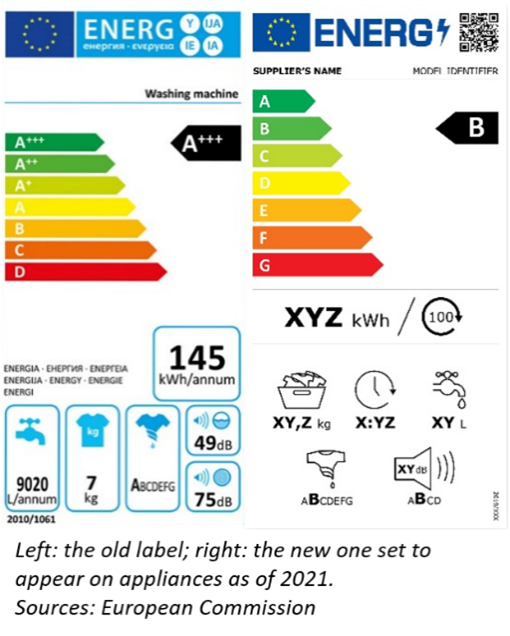
 Since 1 March, a number of household appliances need to be labelled according to a new scale. The change is, in essence, an update of the previous energy efficiency labelling scheme, which had been tweaked over time but looked a bit like it was lagging behind technological developments. Where until last month, thus, fridges could be awarded a A+++ label, meaning a fridge getting a single A was hardly the most energy efficient on the market, the new scale will go from A to G. Further, the scores themselves have been adjusted to enhance the efficiency requirements.

The remake had been in the cards for quite some time - the Commission had already received a 
detailed report in 2014.  According to that study, consumers were not really confused by the old scale; however, it did appear that the least attentive consumers were slightly more sensitive to the difference. Since more careful consumers probably rely on their own research rather than (only) on the labels, it could be that the new scale will help assist consumer decisions over all. 

While the new rules have been welcomed by consumer organisations, criticism has been raised in respect of the somewhat relaxed timing the new rules follow: only a few appliances will immediately display the new labels, with the transition being due to end in 2025 with boilers. 

It is, as ever, not obvious that energy efficiency labelling is a sufficient instrument to lead consumers to make more sustainable choices - beyond achieving some personal savings. In order to boost the effect of these measures and their implementation, it may be worth mentioning that BEUC and other organisations have an ongoing project aimed at communicating not only with consumers but also with other stakeholders. 


Monday, 28 September 2020

Capital Markets Union: the future lies with the better advised consumer-investor

On the 24th of September, the European Commission revealed its new plans for the Capital Markets Union (here and here). With the post-coronavirus recovery in mind, the European Commission suggested a 16-point Action Plan. The Action Plan highlights the struggles that many businesses face in order to stay solvent in the medium and long term. When it comes to consumers, the new Action Plan intends to increase consumer choice regarding savings and investments, which involves better information and better overall protection. The European Commission also makes the case for market-based pension systems, in order to meet ‘the challenges posed by Europe’s ageing population’. 

In particular, the Action Plan highlights that while Europe has one of the highest saving rates in the world, the level of individual investment remains low. In order to increase individual investment, the EU Commission promises to increase trust in capital markets by improving financial literacy. Additionally, the Action Plan highlights the importance of harmonizing disclosure duties on investment products so as to increase comparability of similar products that are currently covered by different legislation. In this sense, the Commission promises to assess whether it can introduce a requirement for Member States to promote educational measures in relation to responsible and long-term investing. Understandable information also plays a central role in the Commission’s plan of attracting more individual investors. In particular, the Commission stresses that although there are already duties in place that impose the disclosure of financial information, the documents produced under those rules are considered ‘long, complex, difficult to understand, misleading and inconsistent’. Additionally, these documents may result in information overload. In this context, the Commission distinguishes between the sophisticated investor – who does not need as much information – and the inexperienced investor – who needs more information. The Commission commits to looking into the applicable legislation and amend it so as to guarantee that consumers receive ‘clear and comparable product information’.

Additionally, the Commission promises to improve the regime applicable to retail investment, to guarantee that an individual investor benefits from, among other aspects, bias-free advice. The importance of transparent information and bias-free financial advice cannot be understated. Financial advisers must be obliged to disclose their own interest in the sale of a given financial product. As BEUC also highlights here, biased financial advice has resulted in considerable financial losses to consumers all over Europe in recent years (see, for example, the case of Banco Espírito Santo in Portugal). In this regard, the Commission acknowledges financial advisors’ role as gatekeepers of the financial system. As a specific point of action, the Commission promises to work towards the harmonization of the threshold of professional qualification of financial advisors, in order to increase consumers’ trust in their advice.