
Thursday, 31 October 2013
Building a house? Online disclosure on construction products' performance


Wednesday, 30 October 2013
Healthcare tourism
On October 25th the new Directive on cross-border healthcare of 2011 had to be implemented in all Member States. This means that currently consumers should be able to at their convenience go abroad in search of medical treatments and medical care. The new rules will make reimbursement claims less formalistic, provide better information to consumers on their patients rights and complaint procedures abroad. Additionally, consumers should be able to easier determine whether a given healthcare specialist is fit for practice and if they are issued prescriptions in another Member State they should be honored by the pharmacists in their country of residence, too. For more information, see Q&A of the European Commission.
 The rules mentioned above harmonize situation of consumers who want to seek medical care abroad and of those who receive prescriptions from another Member State. However, it cannot be said that these rules guarantee patients' safety in Europe. If there are no strict, harmonized rules on authorization of medical devices, consumers could be severely harmed in the process. Imagine buying a pregnancy test during your holidays in another Member State, it being faulty due to more relaxed supervision measures and you ending up believing you are not pregnant and partying weeks long to your health's detriment. To prevent such black scenarios on 22 October the European Parliament looked into another subject related to improving healthcare in Europe - the safety of medical devices. The review of currently binding rules is to bring about more disclosure towards consumers on medical devices and involve them in the monitoring of such devices. A great idea is the facilitation of reporting defects. BEUC still argues for more changes in the newly drafted law, however, asking the European institutions to put a stop to producers using consumers as guinea pigs of their products and instead putting stricter rules on when products may enter the European market. (Parliament opens the door to safer medical devices)
Friday, 25 October 2013
How soon is "by 2015"?
This hope was not unanimously shared by members of the European Council, it seems. Looking at the conclusions drafted yesterday, it seems that the new rules are likely to be slightly delayed , being linked to the completion of the Internal Digital Market "by 2015".
With the new elections coming in May, it is quite possible that the delay might be non-negligible.
(http://www.youtube.com/watch?v=HUMh8GQnDW8)
Several terms of Ryanairs general conditions found unfair by Spanish court
 This week, a Spanish court has declared no less than eight terms in Ryanair's terms of service unfair, and thus invalid.
Among them, the infamous fee imposed on passengers failing to show their printed boarding card at the airport, but also the diversion of all complaints from the "local" (for the consumer) authorities to those of Ireland.
It is hardly imaginable that Ryanair will want to spontaneously complain with the decision. On the other hand, it might also be not so eager to see the case brought further in the judicial system and, possibly, to end up at the Court of Justice of the European Union.
This case might be the beginning of an interesting saga....
Wednesday, 23 October 2013
Parliament calls for suspension of SWIFT agreement
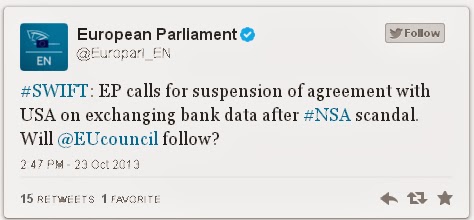
As we had anticipated, the European Parliament's plenary session has voted in favour of a resolution asking the suspension of the EU-USA SWIFT agreement, after allegations that the American NSA abused of the system to "spy" on European citizens.
The vote was quite tight, with 280 MPs in favour of the suspension, 254 against it and 30 abstentions.
The vote was quite tight, with 280 MPs in favour of the suspension, 254 against it and 30 abstentions.
Now of course the question is- what will be the consequences of this (non-binding) vote?

(to be continued)
(to be continued)
Tuesday, 22 October 2013
MEPs raising stakes on EU data protection
Yesterday, the EP civil liberties committee voted to endorse the data protection package proposed by the Commission (one directive and one regulation) , giving the Parliament a full mandate to engage in negotiations with MS representatives and get the new rules passed as soon as possible.
 The new measures should, in particular, introduce clearer safeguards for European citizens when interacting- especially on the Internet- with counterparts settled in non-EU countries.The MPs stressed how the urgency to adopt such measures has been made clear by the mass surveillance cases which started to be uncovered at the beginning of last summer and are, as it seems, still unravelling.
 Three are the main features of the proposed legislation:
1) need for authorisation: no provider should be entitled to transfer data concerning European citizens or Europe-originated information without an authorization from European data protection authorities (and without informing the person concerned);
2) important sanctions would be imposed on companies breaching those requirements;
3) citizens should be entitled to manage their data: which means that no data should be collected without the explicit assent of the person affected and that one should always be entitled to obtain erasure of the information which concerns her.
The Parliament hopes to see the negotiations through before the coming European elections, to be held in May 2014.
P.S. 23/10/2013: As I write the Parliament is voting on the possible suspension of the SWIFT agreement between the EU and the US, due to suspects that the latter were abusing of it in order to process EU citizens' financial data outside the scope of the protocol. We will keep you posted on the results of this (non-binding) vote.
Monday, 21 October 2013
Downloaded any goods recently? - consumer protection standards
The European Commission conducts regular sweeps - checking the enforcement's level of EU consumer protection measures by European websites. Last December a sweep was conducted to see whether websites selling digital consumer products (games, books, videos and music) are in compliance with EU legislation. The sweep that took place in the summer of 2012 showed that over half of the investigated websites (172 out of 330 checked websites) was not compliant with EU rules. (Q&A - Sweep on on-line games, books, videos and music) After that sweep, the authorities issued advice and warnings to websites that were potentially in breach of EU rules. As a result, the repeated sweep revealed that out of 172 previously non-compliant websites, 116 have been corrected. Altogether, 80% of the examined 330 websites is now compliant with EU consumer law. (Better protection for EU Consumers downloading games, e-books, videos and music) This means that consumers should be getting better information nowadays on products' attributes, should be informed fully and comprehensively on their rights (e.g., the fact that when the download starts consumers lose their right of withdrawal), on how to contact the sellers with their complaints, have been provided with fair contract terms. The conducted studies revealed also that consumers are still insufficiently informed about the following facts:
- that they are giving up their right of withdrawal with the start of a download (42% websites don't provide this information);
- that they have a right to take a legal action or claim compensation when the product doesn't work;
- how to contact the trader;
- that the product may have geographical restrictions that would make it impossible to use it abroad if consumers travel;
- that digital games that are advertised as 'free' could upon downloading and use still requirement certain payments being made.
The enforcement actions will continue to be conducted. It is especially relevant to increase children protection when purchasing digital goods, since they are often users of digital goods and are more vulnerable consumers, more prone to succumb to misleading commercial practices.
The European Commission advises consumers to think whether they have an answer to the following questions prior to making a purchase decision:
- Can you contact the trader in case there is a problem? Make sure that the trader provides his name, geographical and e-mail address.
- Do you have all the information you need about how to run the download? Check that you are given sufficient information and minimum operating system requirements of the product such as size, quality and whether a device or particular software is needed in order to operate the digital content product.
- How much is it really going to cost? Look out for the final price; including taxes and all charges that may be hidden in the last stages of the payment process.
- Do you have a right of return? Be aware that once you have started downloading the product, you have usually no right to return it.
- Are your rights being restricted? Beware of terms that exclude the trader from various liabilities and redress mechanisms including legal action; they are probably unfair.
- Where can you use the digital content? Look for information whether you can use the digital content in another country than the one you live in. You may get a nasty surprise if you are travelling or on holiday. Contact the sales office for advice, if you do not find the information.
- What is the real cost of the "free" kids game? There might be add-ons requiring payment without you being warned about it beforehand.
Friday, 18 October 2013
Parliament endorsing proposed EU e-signature
On Tuesday, the European Parliament's Industry committee has voted to endorse a proposal by the commission aiming at imposing mutual recognition if e-signature mechanisms in the Internal Market.
 |
| The official Dutch way to e-signature |
The proposal would require member states to mutually recognise each other's
national electronic identification systems, but also require that such systems be reported to the European Commission. Existing national systems would accordingly not
have to change, but would be classified according to their level of security.
This should make it easier for parties negotiating cross-border contracts to identify themselves. Even more importantly, EU citizens moving from one country to another should be able to "carry along" their e-signature and use it to interact also with public administrations different than the one which has issued it.
The negotiations on the future instrument, which interestingly enough seems like a piece of secondary legislation aiming at negative integration without any previous harmonization effort, will probably begin next month.
Total recall?

Product safety is an emotional subject that is being brought up more often nowadays. Since technology and communication keeps on improving, it is no wonder that in the legal world we tend to focus our attention nowadays more on preventing product defaults (therefore, regulating product safety and promoting unsafe product recall) rather than on product liability (regulating consequences of product defaults). Anyone who has heard stories about laptops overheating on their users' thighs (How the heat from a laptop can 'toast' the skin on your thighs) or children choking on toy parts (Two Children's Toys Recalled Due to Choking Hazards) would be happy to hear that yesterday the European Parliament's Consumer Protection Committee adopted two reports on: product safety and market surveillance. These reports aim to contribute to the review of current European product safety rules, by strengthening consumers' information rights and further regulating product safety requirements. (see our previous post: Product Safety in 2013)
Some of the introduced by the MEPs changes in the current Product Safety Directive promote a new, voluntary, third-party issued safety label (EU Safety Tested mark) as well as make a label on product's country of origin mandatory, in order to increase transparency.
"Where a good was produced in more than one country, the country of
origin will be where it underwent its "last, substantial, economically
justified processing or working in an undertaking equipped for that
purpose and resulting in the manufacture of a new product or
representing an important stage of manufacture"." (Internal Market MEPs tighten up product safety and market surveillance rules)
The MEPs also brought back to the draft the 'precautionary principle' that Commission's Members wanted to remove from the currently binding rules. Pursuant to this principle, some products may need to be removed from the market faster, since consumers are given the benefit of the doubt as to their safety. Another interesting addition is a provision pursuant to which a pan-European database on product-related injuries suffered by consumers would be created. This could make it easier to monitor a product that enters a few different European markets at the same time. It was also suggested to introduce a public EU-wide blacklist that would name all firms that have been 'repeatedly found to have intentionally breached' EU product safety rules.
The vote in the plenary on these two new regulations is planned for December this year. (Interview: how new product rules will improve safety for consumers)
Thursday, 17 October 2013
The existence of a causal link is not a condition for consumer protection - CJEU judgment in Case C-218/12 Emrek
Today, the Court of Justice of the EU handed down its judgment in Case C-218/12 Emrek. For a description of the facts of the case and AG Cruz Villalón's opinion, I refer to an earlier post on this blog ('The missing link').
The Court follows the AG and observes that:
'it must be held that the requirement of prior consultation of the Internet site by the consumer could give rise to problems of proof, in particular in cases where the contract was not concluded at a distance through that site, as in the main proceedings. In such a situation, difficulties related to proof of the existence of a causal link between the means used to direct the activity, that is an Internet site, and the conclusion of a contract, would tend to dissuade consumers from bringing actions before the national courts under Articles 15 and 16 of Regulation No 44/2001 and would weaken the protection of consumers which those provisions seek to achieve.' (para. 25)
Accordingly, the Court holds that:
'Article 15(1)(c) of Council Regulation (EC) No 44/2001 of 22 December 2000 on jurisdiction and the recognition and enforcement of judgments in civil and commercial matters must be interpreted as meaning that that it does not require the existence of a causal link between the means employed to direct the commercial or professional activity to the Member State of the consumer’s domicile. However, the existence of such a causal link constitutes evidence of the connection between the contract and such activity.'
See also the CJEU's press release on the case.
Subscribe to:
Posts (Atom)