Today the EU Commission reminded us on a study conducted by Deloitte Luxembourg on Distribution system of retail investment products across the EU published in April 2018. The study investigated how well EU retail investment markets work for consumers, covering 15 Member States. Unsurprisingly, the study concluded that although consumers have choice, they face significant challenges in collecting and processing information for making good investment choices (see the summary of findings here and the full study here).
Thursday, 28 June 2018
Wednesday, 27 June 2018
C-191/17 AG Tanchev on the notion of 'payment account'
Last week Advocate General Tanchev delivered a not very
‘consumer friendly’ opinion
in case C-191/17 Budeskammer fur Arbeiter und Angestellt v ING-DiBa
Direktbank Austria Nidererlassung der ING-DiBA AG. Referred by the Oberster
Gerichtshof (Supreme Court of Austria) this case involves the the
interpretation of Article 4 (14) of Directive 2007/64/EC on payment services in
the internal market (PSD 1).
Representing consumer interests the Budeskammer fur
Arbeiter und Angestellt brought an action against ING-DiBa Direktbank Austria
alleging that the bank’s ‘Direkt-Sparen’ (‘direkt-savings’) product
(referred to as online direct savings
account) contains a large number of standard terms and conditions that are
not compliant with the Austrian law transposing PSD1. Given the special nature
of the financial product, the subject of the dispute became the scope of PSD1,
i.e. whether this particular kind of account qualifies for a payment account
within the meaning of PSD1.
Article 4 (14) PDS1 provides that a 'payment account' is an account held in the name of one or more payment service users which is used for the execution of payment transactions. The definition itself neither specially refers to nor specially excludes the particular product in question.
What is an online direkt savings account and how it works?
The online direct savings account is a particular kind of bank account. It is labelled as a savings account, i.e. that should be used for depositing money for saving purposes. however, access to this account is granted via online banking, enabling consumers to make deposits and withdrawals from the account. Any transfer however must be carried out through another account called a reference account. The reference account must be a current account opened in Austria, but can be held by any Austrian bank, it does not have to be held with the same bank that holds the online direst savings account. A consumer is able to decide, without any restriction or notice when and in what amount the consumer transfers money between the online direct savings account and the reference account.
Is the online savings account covered by PSD1?
Interpreting the provision in question in the context of other provisions of PSD1 (other definitions within Art. 4, Art. 2, and the Annex) and related EU legislation (Directive 2014/92/EU and Regulation 260/2012) AG Tanchev concluded that the particular product cannot be considered to be a payment account within the meaning of Article 4 (14) of PDS1, because this account does not involve ‘direct participation in payment transactions with third parties’.
Our evaluation
Although AG Tanchev rightly said that the mere labeling of an account as a ‘savings account’ is not in itself an indication that the account does not constitutes a ‘payment account’ within the meaning of PSD1, what seems to have been determinative in his reasoning was that the online direct savings account is not intended to be used for transactions between the consumer (account holder) and third parties, essentially accepting the argument of the defendant bank. Whilst this may be true, if the account allows for consumers to execute payment services consumers would surely deserve to have the same level of protection that belongs to users to payment accounts. According to AG Tanchev, this protection will be provided for consumers via the protection they enjoy buy the underlying, reference account. Whilst this may be correct, by the same token, applying a different regime for the two accounts creates uncertainty and opens a potential protection gap for consumers. In case of a future dispute, the bank holding the online direct savings account would be able to use the same argument as a shield against their liability; that the higher level of protection offered by PSD1 attached to the reference account does not apply the transaction executed though the online savings account, because the transaction was attached to that separate account and not to the reference account. The situation gets even more complicated leaving consumers with less access to redress when the two accounts are held by different banks.
At this instance we must agree with the EU Commission’s
submission that argued against the restrictive approach in interpreting the
scope of PSD1. The EU Commission stressed that the purpose of PDS1 is to confer
protection on the users of payment services: as mentioned in recital 46
and in the articles of Title IV of PSD1. The accounts covered by PSD1
benefit from certain minimum regulatory requirements for the proper execution
and processing of payment transactions, and such protection is denied to
consumers in the event of a restrictive interpretation of the notion of a
‘payment account’ within the meaning of PSD1 (para 21).
Whilst the opinion involves the interpretation of PSD1, it remains relevant in the light of the current PSD2 that contains exactly the same provision in Article 4 (12) and seems to makes no special reference to the features of the product under scrutiny here.


Monday, 25 June 2018
BEUC position paper on artificial intelligence
Last week BEUC published a very interesting paper on Automated decision making and artificial intelligence: a consumer perspective. The paper highlights the main challenges raised by AI and suggest ways to tackle these. Importantly, the paper calls for an EU Action plan on AI that would set out new consumer protection concepts and a comprehensive plan to update the old consumer protection tools. The position paper is a must read for everyone interested in the impact of new technologies on consumer protection.
Representative actions in the Visegrád 4 countries – real improvement? by Rita Simon
This is a guest post by dr Rita Simon from the Institute of State and Law at the Czech Academy of Sciences that has been based on a report prepared by her for BEUC
Representative actions in the Visegrád
4 countries – real improvement?
Mass harms cause a mass of problems. In mass harm situations, collective claims
constitute a better means of access to justice than individual ones, especially
regarding bagatelle harms. Although certain collective redress mechanisms exist
all over Europe, their effectiveness is questionable. Studies such as “Evaluation
of the effectiveness and efficiency of collective redress mechanisms in the
European Union” and the “Fitness check of consumer law” showed that the existing
redresses are rarely used or they do not produce the desired results, in almost
all Member States. We can also observe the ineffectiveness of injunction
actions in the V4 countries. The New Deal for Consumers, which has been
published in April this year, aims to
strengthen the enforcement of consumer rights, which is the Alfa and Omega of
consumer protection. The proposed way of improving enforcement by the European
Commission follows the German, Austrian and French practice: the launch of representative
actions by consumer organisations will be supported more strongly by the
Commission. However, the question of whether such actions could be the best
solution for enforcing consumer rights and access to justice in the V4
countries should be posed.
Injunctive reliefs
Depending on who has the right to file for an injunction and how effective
the action is in practice, some key differences should be observed. In the Czech
Republic, only consumer protection organisations can file for injunctive relief;
in the other three countries some control authorities, such as the financial surveillance
authority or office of consumer protection or consumer ombudsman can also initiate
injunction actions. How often these authorities file an action often depends on
the consumer policy of the government in power. An interesting fact is that in
Hungary – similarly to in Spain - the state advocate also has the right to file
an injunctive action if the public interest is affected. Such actio popularis actions have been very effective
in eliminating unfair clauses, e.g. in financial service contracts. The yearly total
of filed injunctive actions is very low in the Visegrád 4 countries, at not
more than 1-2 actions per country. However, it should be pointed out that in
Hungary and Poland compensatory collective redress is available in combination with
an injunctive action, which significantly increases the impact of such a redress.
In contrast with this, in the Czech Republic, the consumer organisation often withdraws
the filed action, because of the length of the procedure or due to competency
problems between the courts and other supervisory bodies. In Poland, the
President of the Competition and Consumer Protection Office (UOKiK) does not have an obligation to initiate an
injunction procedure automatically at the request of a consumer organisation or
the ombudsman; it is at his discretion. A further criticism is that an
injunction decision against a foreign trader is not enforceable, and it is
reported in all the Visegrád countries that consumer organisations generally
lack sufficient financial and human resources. The impossibility of consumer organisations
to demand monetary compensation is problematic in the Czech Republic and
Slovakia.
Other existing mechanisms – class action, and actio popularis
Class action mechanisms as a form of group action have been in force
since 2010 in Poland, and in Hungary since January 2018. Group actions popped
up in Poland like mushrooms and were filed in very different areas, such as
construction disasters, mass poisoning and unfair clauses in credit or travel
contracts, but also against motorway operators and against a regional
authority. The number of suits initiated is over 100, but many claims were rejected
due to the limited scope of application of the class action. Class actions can
be initiated exclusively regarding tortious conduct and product liability, but
claims for personal injury and infringement of human rights (health, body integrity, good reputation image, etc.) are excluded from the
scope. In contrast, the Hungarian scope of application does not exclude
personal injury, but limits the fields of law in which class action can be
used. Therefore, a group action can be filed in Hungary in labour and consumer
disputes and over some health claims resulting from environmental damage. Group actions
in both countries follow in some respects the US class-action model but, regarding
joining the group, just an opt-in possibility is given, and the Polish model in
particular contains numerous safeguards to avoid malicious, ruinous claims.
As other interesting collective redress, Hungary improved its “actio popularis” rules in 2012 and
differentiated between so-called public
interest actions and public interest
enforcements, which can be commenced if the infringement has harmed a large,
identifiable group of consumers, or has caused a significant disadvantage. The
public interest action can end in two ways, first with a declaratory judgment establishing
the infringement or second with a cease and desist order on its own or with a
case order accompanied by a restitution order. In the first model, which ends
with the declaratory judgement, consumers have to file a simplified follow-on
damages claim. In this claim, they need to prove the causal link between the
infringement and the extent of the damage suffered. A public interest enforcement presumes a prior administrative process
that has established the infringement. Despite high expectations, this type of
claim has so far not achieved its purpose. Collective actions have been filed much
less often after the amendments than before 2013. This can be explained by the
continuing decline in consumer financing and the abolition of the Department of
Collective Action at the Consumer Protection Agency. In addition, the
reluctance of consumers to file follow-on complaints regarding the damage suffered
needs to be emphasised, as does the lack of information on the existence of actio popularis decisions.
Unlike in Hungary and Poland, the two other Visegrád countries have not
introduced new group action mechanisms yet; the Czech legislator is working on
a class-action proposal, but the new government has not given
priority to this entering into law. Business associations, especially the
banking association, have been trying to have the legislation shelved until the
new Directive on representative actions has been announced.
Are representative actions suitable collective redress models for the V4
countries?
The proposal for the Directive allows "qualified entities",
such as consumer organisations (but also ad hoc entities), to launch actions on
behalf of all consumers. These entities will have to satisfy minimum
reputational criteria (they must be properly established, not for profit and
have a legitimate interest in ensuring compliance with the relevant EU law).
Compensatory collective redress actions will also be available. A very
important feature of these actions is that, in order to protect the interests
of consumers, the above-mentioned entities will be entitled to seek redress by
repairs, exchanges, reductions and termination of the contract or repayment of
the purchase price. A very interesting innovation is that if a prior
administrative or court decision has assessed an infringement, it should be
taken as irrefutable evidence in any subsequent redress action not just in the
same but also in other Member States. This emphasis on the acceptance of court
and administrative decisions should avoid legal uncertainty and unnecessary
costs for all parties, including the judiciary. Such a new development could certainly
bring positive changes; the only question to pose is whether the legitimacy of
bringing representative actions should be reserved for consumer associations
alone.
In the Visegrád 4 countries, there is considerable concern that - due to
the lack of funding of consumer organisations and the impossibility of
receiving funding from third parties - these entities will not be able to
perform properly. The situation, which has been observed in current injunction
practices, will not improve in the future. It should therefore be recommended
that other state organisations (e.g. consumer authorities, the ombudsman,
financial supervisory authorities and trading standards agencies) should also receive
the right to launch these collective actions. The state organisation has better
access to evidence and it has a bigger legal department than consumer organisations.
To support the participation of consumers in civil law proceedings, it seems useful
to introduce parallel “clean” opt-in class action models in all the Visegrád
states. It is also recommended to define the form and content of simplified
individual follow-on-damage claims, similar to the Hungarian model after public interest/enforcement actions. These
changes should be proposed with sufficient precision at the European level,
because otherwise is can be assumed that the national legislatures of some
countries (including the Visegrád states) would not make their collective redress mechanisms significantly
more effective, due to the resistance of business and banking associations. Without
simple, clear and feasible collective redress, the enforceability of consumer
rights will not improve in Slovakia and the Czech Republic at all and just a
new rule on paper will be announced.
Wednesday, 20 June 2018
Workshop 'Vulnerable consumers or citizens?'
Christine Riefa (Brunel University) and Severine Saintier (University of Exeter) are organising a workshop Global Consumer Lives: '(Vulnerable) consumers or citizens?: is there a correct rationale for a fairer access to justice' on July 10 at Brunel University. Find more information at this website.
Friday, 15 June 2018
AG opinion in Wind Tre: aggressive practices require active conduct
 On the 31st of May the
AG Campos Sánchez-Bordona's opinion in the Wind Tre cases (C‑54/17 and C‑55/17) was published. This is the first case where the meaning of
aggressive commercial practices is discussed, making it highly important.
Before Wind Tre the only ECJ case on aggressive practice was Purely Creative (C-428/11), in which one of the blacklisted practices was contested, without invoking art. 8-9 of the Unfair Commercial Practices Directive (UCPD, Directive 2005/29/EC).
On the 31st of May the
AG Campos Sánchez-Bordona's opinion in the Wind Tre cases (C‑54/17 and C‑55/17) was published. This is the first case where the meaning of
aggressive commercial practices is discussed, making it highly important.
Before Wind Tre the only ECJ case on aggressive practice was Purely Creative (C-428/11), in which one of the blacklisted practices was contested, without invoking art. 8-9 of the Unfair Commercial Practices Directive (UCPD, Directive 2005/29/EC). In the Wind Tre case the issue of the relationship between sectoral legislation, such as the Universal Service Directive (Directive 2002/22/EC), as lex specialis to the UCPD and the general rules of the UCPD is discussed.
Facts of the case
The dispute concerned the marketing of mobile phones in Italy. The mobile
phones came with SIM cards which had answering and internet services
pre-installed, of which fact consumers had not been informed. It is important to
note that there was no complaint as to the cost of these services or the
information provided about their function, the complaint was about telecom
companies omitting to inform consumers that these services were pre-installed.
The same practice was used by two companies, Wind Tre and Vodafone Italia,
and the Italian Market Authority (Autorità Garante della Concorrenza e del
Mercato, hereafter AGCM) imposed fines on the two companies for engaging in an
aggressive practice. The telecom companies challenged that decision in court,
claiming that the AGCM lacked competency to impose fines stating that the
telecommunications authority (Autorità per la Garanzie nelle Comunicazioni,
hereafter: AGCom) was responsible instead. This argument was based on art. 3(4)
UCPD stating that in case of a conflict between the UCPD and other sectoral rules
on unfair commercial practices, the latter will prevail and apply.
The case reached all the way to the Council of State (Consiglio di Stato)
which ruled in favour of the competence of the AGCM stating that the practice
was aggressive within the meaning of the Italian Consumer Code (transposing the
UCPD). It argued that even though sectoral legislation of the
telecommunications sector was also breached, the case in question presented a
‘progressive harmful conduct’, which gave rise to a more serious infringement,
thus making the application of the Consumer code, instead of the sectoral
legislation, appropriate. (para 25)
Questions
The Italian court referred 7 questions, which the AG Campos Sánchez-Bordona, with the agreement
of all parties, summed up into the following two groups (para 32).
- Can the conduct of the telephone operators be classified as an ‘unsolicited supply' (as per point 29 of Annex I of the UCPD) or an aggressive commercial practice?
- According to art. 3(4) UCPD should the UCPD cede to other EU rules, and, if so, to national provisions enacted in implementation of those rules?
The first group of questions refers is of a substantive nature as to
whether the practice in question can be characterised as aggressive according
to the UCPD; either using the blacklist of the UCPD, or by using art. 8-9 UCPD.
The second group of questions refers to the relationship between the UCPD
and other EU sectoral legislation as lex specialis.
AG's Opinion
In answering the first question, AG Campos Sánchez-Bordona provides us with what has been
the most detailed analysis of the elements of aggressive commercial practices
by the Court to this day.
Inertia Selling
He begins to first examine whether the practice in question can be caught
by the blacklist, and specifically point 29 forbidding inertia selling.
According to the AG, there are two conditions to satisfy simultaneously: 1) unsolicited supply
and 2) unlawful demand of payment (para 44).
From the facts it can be established that the phone operator had not
properly informed consumers on the pre-installed services on the sim card,
meaning that consumers could use them without configuring them. AG Campos Sánchez-Bordona examines
whether this supply, of which consumers were not informed of, qualifies as
‘unsolicited supply’. In his opinion ‘unsolicited’ means more than not being
provided with essential information on a service, it means that the consumer
was not aware of its existence (para 48).
The AG finds that a consumer (and not the average consumer) has no reason
to expect that services have been preinstalled, if he has not been
informed thereof and which he has to opt out of by using a process which he is likely to
be unaware of (para 53).
Hence, whilst in this case unsolicited supply is possible, the AG does not find the same
for the demand for payment. In his opinion not any demand for payment could fulfil the
conditions of point 29, but it needs to be an undue request for payment. The
referring court specifies that there was no complaint as to the cost of the
services or the information about them, only about the lack of information about the pre-installation.
AG Campos Sánchez-Bordona argues further that the average consumer could expect that the SIM card
purchased would be able to provide him with services about the costs of which
he has been informed.
It is worth noting that the AG makes reference to the average consumer in the context of the blacklist, where the average consumer test is not meant to apply. This goes to show that the blacklist does not offer the legal certainty promised.
It is worth noting that the AG makes reference to the average consumer in the context of the blacklist, where the average consumer test is not meant to apply. This goes to show that the blacklist does not offer the legal certainty promised.
Based on the above reasoning, point 29 of Annex I of the UCPD on inertia selling is not
applicable. The next step is to examine whether the practice can be caught by
art. 8-9 UCPD.
Aggressive Practices
The focus is on the practice in question being one of omission of information.
AG Campos Sánchez-Bordona looks to the factors of art. 9 UCPD to determine what would qualify as a
practice using the notions of: harassment, coercion or undue influence. Out of art. 9 UCPD the
AG deduces that harassment and coercion cannot be applied in this case as they
require ‘active conduct, which is not
present in the case of an omission of information’ (para 64).
It is not clear how the AG reaches that conclusion, as the factors of
art. 9 UCPD apply for all three categories of harassment, coercion and undue
influence without distinction. Also, even the omission of information requires an
active choice of the trader to omit that information, so one could argue that
active conduct is not entirely absent.
The AG continues to examine solely whether the practice can be caught
under the concept of undue influence. Undue influence is the only one defined in UCPD in its art.
2(j), unlike harassment and coercion.
Undue influence refers to exploitation of a position of power which
significantly limits the ability of the consumer to make an informed decision.
The AG differentiates between two different kinds of positions of power (para
67):
- Exploitation of a position of power which allows the trader to infringe the consumer’s freedom when it comes to buying a product.
- Position of power held by a trader who, following the conclusion of the contract, may claim from the consumer the consideration which the latter undertook to provide on signing the contract.
Consequently, the AG defines a position of power in undue influence as both applying in pre-sale and
post-sale conditions. What is to be noted is the focus on the fact of the conclusion of a contract,
of consideration of the terms, that is the use of contract law terms through which aggressive practices seem to be defined. However, aggressive practices are broader than that, to
the extent that they cover all transactional decisions of the consumer and are
not limited to the decisions to enter into a contract.
The opinion explains that the aim of prohibiting aggressive practises is,
in essence, protecting the freedom of contract, as consumers should be bound only
by obligations that they freely entered into. So the criterion is whether
the omission of information about the pre-installation impaired the freedom of choice
of the consumer to the extent, where he accepted contractual obligations he
would not have otherwise (para70).
AG Campos Sánchez-Bordona found the practice not to be aggressive, as according to him, the
practice was not sufficient to impair the freedom of the consumer to such an
extent that he would not have entered the contract. The AG does not elaborate
on how he reached that conclusion or what is the standard against which it is
weighed. This view of aggressive practices appears to raise the standard,
making it more difficult to show that impairment of the freedom of choice of
the consumer is indeed significant enough.
Lex specialis
Given the answer to the first two questions, there was no reason to
examine the rest, on the conflict of law, yet the AG did submit his observations.
In these he makes the accurate observation that the UCPD is not designed
to fill the gaps that sectoral legislation leaves; instead it offers its own
stand-alone system of protection which exists in parallel with the sectoral
legislation (para 94). This sets the tone also for art. 3(4) UCPD that should be
interpreted strictly as focus should be on maintaining a high level of
protection. Therefore, art. 3(4) UCPD is better conceptualised as regulating
conflict between provisions and not systems of sectoral legislation (para 111).
In this case, it means that the existence of sectoral legislation that covers
aspects of unfair commercial practices does not preclude the application of the UCPD.
AG Campos Sánchez-Bordona didn’t find a conflict in this case between the UCPD and the
Universal Service Directive, but rather the need for them to be applied
jointly (para 129). The Universal Service Directive regulates the information
requirements, which are crucial for determining whether there was unsolicited
supply as per point 29 of the Annex I of the UCPD.
Conclusion
This is an intriguing case, as it
is the first of its kind for aggressive practices in the UCPD. It reveals
contrasting interpretation of the UCPD notions and objectives between the Member States and AG Campos Sánchez-Bordona. Italian authorities
viewed aggressive practices as a tool for penalising the abuse of power by the
trader. The AG on the other hand interpreted the same provisions focusing on
protecting consumers' contractual freedom, especially as applied to the decision to enter into a contract.
It remains to be seen what the Court will decide and this blog will follow the
developments with great anticipation.
Thursday, 14 June 2018
"Food labels: tricks of the trade" - BEUC's report
On the same day that the Commission announces common methodology on comparing quality of similarly packaged food products, BEUC publishes its report "Food labels: tricks of the trade" on misleading labeling practices in the food sector in the EU (see more Food labels can fool you...). Three practices that have been further elaborated on are:
- labeling products as 'traditional' or 'artisanal';
- displaying fruit pictures on packaging for products that have little or no actual fruit content;
- labeling as 'whole grain' products with barely any fibre.
BEUC calls for:
- more definitions on the EU level of commonly used terms on food products' labels, such as 'natural', 'traditional' or 'artisanal';
- setting a minimum level of whole grain content for 'whole grain' claims;
- setting a minimum level of content for ingredients pictured on the front of the pack, e.g. fruits;
- obliging traders to display on the front of the pack the percentage of the advertised ingredient.
 |
| E.g. the report mentions that while this product has many fruits on the packaging, they are only 2.5% of all ingredients |
Quality matters
 Today the Commission has published a new common methodology that will allow national authorities to compare the quality of food products across the EU, when they compare the composition and characteristics of these food products (Dual quality of food...). The idea behind this project being that currently similarly branded or packaged food products may differ in composition to an extent that is misleading to consumers, but the comparison between these products as well as the finding of misleading action would differ per Member State, leading to different levels of consumer protection. This common methodology emerged from the activities of the Joint Research Centre (JRC), the European Commission's Science and Knowledge service, which facilitate evaluation of differences in the quality of food products in an objective way.
Sweep of telecommunication and other digital services websites
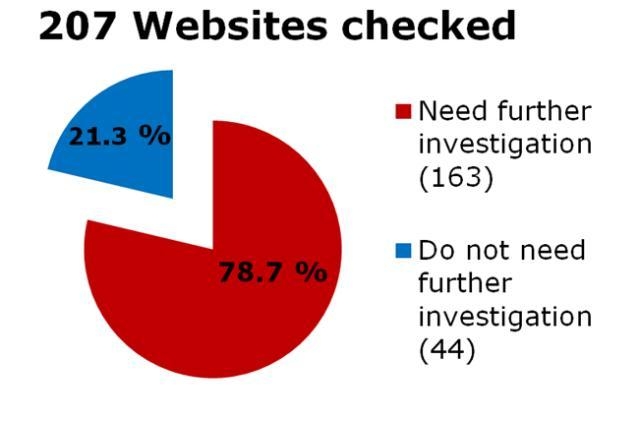
On May 18 the European Commission and national consumer protection authorities published their new sweep report revealing misleading commercial practices adopted by websites offering telecommunication (e.g. fixed/mobile phone, internet) and other digital services (e.g. streaming) (see more Buying telecom services online...). Out of 207 screened websites - 163 could be currently infringing EU consumer law. The most common suspicious practices concerned:
- incorrectly advertising certain packages as free or discounted, as in fact these belonged to a bundled offer;
- not offering a dispute resolution system (or link to ODR);
- maintaining a possibility of unilateral change of T&Cs without adhering to rules on notification or providing a justification;
- providing incorrect or misleading information on refunds in case of either withdrawal from the contract or non-conformity;
- automatic contract renewals without properly informing consumers about this.
 |
| From the EU Commission website |
Thursday, 7 June 2018
Connecting fights saga tbc - AG Tanchev in flightright (C-186/17)
Last week we have discussed the judgement of the CJEU in the case Wegener (C-537/17), in which the CJEU confirmed that it doesn't matter whether a delay upon the arrival at the final destination was caused by a delay of one of the connecting flights, as long as they were part of one booking, the passenger could claim compensation from art. 7 Regulation 261/2004. Yesterday, AG Tanchev had to address this issue again in an opinion to the case flightright (C-186/17).
The difference between the factual situation of these two cases was that the contractual air carrier differed from the operating air carriers. In this case, passenger booked his flights through a tour organiser, who had a contract with Air Berlin. The latter air carrier has, however, on the basis of code sharing agreements, allowed the contract to be performed by Iberia Express, Iberia and Avianca - three air carriers for three flights of the whole, connected journey from Berlin via Madrid (first flight) and via San Jose (Costa Rica) (second flight) to San Salvador (El Salvador) (third flight). The first flight, operated by Iberia Express, was delayed - only by about an hour, but this led to a missed connection and arrival in El Salvador with 49-hour delay.
Surprisingly, the German court dismissed the claim against Iberia Express, claiming that they weren't the operating air carrier on all flights and that they were not involved in the planning and booking of the journey, and, therefore, could not have taken the operational risk of short connection times. This would have been an acceptable reasoning except that provisions of the Regulation 261/2004 are crystal clear in assigning the obligations towards passengers (incl. compensatory ones) to operating carriers - regardless whether they have had contractual relationships with the passenger and, therefore, whether they have planned the flights. On the basis of code sharing agreements, the operating carrier could possibly try to claim redress from other involved parties (on the basis of Art. 13 Reg 261/2004). Such division of liability facilitates high level of consumer protection - as it is easiest for passengers to turn towards the operating carrier with their claims - as well as prevents possible manipulation of flights by air carriers, trying to evade liability by splitting up flights (see para 41 of the opinion, as well).
AG Tanchev rightly then advises the CJEU to recognise the need to hold the operating air carrier liable.
Subscribe to:
Posts (Atom)