Showing posts with label energy. Show all posts

Saturday, 16 October 2021

Energy price spike: Commission announces toolbox including consumer alleviation measures

Europe – like most of the world – sits in the middle of an energy crunch. Natural gas prices have gone up in the three digits (!) since 2020 and consumers are feeling the brunt: to give but an example, in the Netherlands several smaller companies have either informed their consumers that their monthly payments will have to go up considerably starting next January, or even have tried to terminate their fixed-term, fixed-price contracts in advance – to the point that the Consumer authority warned them that they do, in fact, need to comply with their contractual obligations (or go to court, one may add).

The spike in gas (and oil) prices has been mainly caused by the global production chains picking up again as the pandemic seems to have gone past its peak moment. For consumers, however, the origins of the phenomenon are less salient than its consequences on their ability to heat their homes this coming winter. Furthermore, energy anxiety in advanced and high-impact countries risk undermining the energy transition goals that have been set up in the past few years: suffice it to say that China has announced that its plans not to open new coal power plants will have to be reconsidered. 

Against this background, the Commission has announced this week a “toolbox” meant to guide Member States in the effort to soften the impact of this new crisis on consumers, and in particular vulnerable households who suffer or are exposed to energy poverty. While some elements in the toolbox are related to general energy policy and hence not so interesting to report on here, a few are worth mentioning, in particular:

  •     Provide emergency income support for energy-poor consumers, for example through vouchers or partial bill payments, which can be supported with EU ETS revenues;
  •       Authorise temporary deferrals of bill payments;
  •       Put in place safeguards to avoid disconnections from the grid;
  •       Provide temporary, targeted reductions in taxation rates for vulnerable households; 

The first measure seems to be inspired by actions recently taken in France, but also seems to mirror practice in the (formerly MS) UK. It goes without saying that this could be difficult for some MS to bear, especially after years of crisis in which the pandemic has already put a strain on public finances.  

Deferrals may be a more attractive option for public actors, but they may exacerbate problems for providers, some of which have – to take the UK’s example – already declared bankruptcy since last month.  

Safeguards against disconnections should be already part of the policy kit in this area. According to both the 2019 Electricity Directive and the Natural Gas Directive, Member States have the option to ban disconnections “at critical times” to protect vulnerable consumers. What these critical times are, however, is not defined, and neither is the notion of vulnerable consumers – which may or may not, according to the directive, refer to energy poverty.

The Commission’s communication emphasizes that in the long term, energy transition is the best insurance against price fluctuations on the fossil markets. This process, according to the Commission, should thus not be jeopardized by the current crisis. 

The toolbox has been positively received by BEUC; Member States, however, may or may not be receptive to the Commission’s push to put immediate relief centerstage, being divided on many points including the extent of the current threat for prices on their own as well as social cohesion. 

Wednesday, 10 March 2021

New energy labels start rolling out

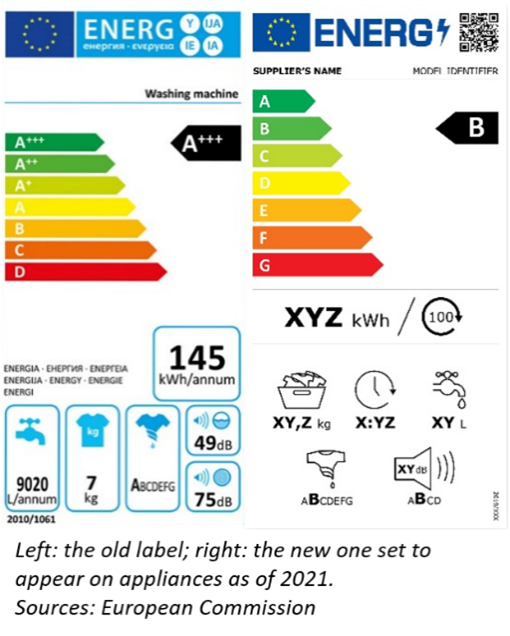
 Since 1 March, a number of household appliances need to be labelled according to a new scale. The change is, in essence, an update of the previous energy efficiency labelling scheme, which had been tweaked over time but looked a bit like it was lagging behind technological developments. Where until last month, thus, fridges could be awarded a A+++ label, meaning a fridge getting a single A was hardly the most energy efficient on the market, the new scale will go from A to G. Further, the scores themselves have been adjusted to enhance the efficiency requirements.

The remake had been in the cards for quite some time - the Commission had already received a 
detailed report in 2014.  According to that study, consumers were not really confused by the old scale; however, it did appear that the least attentive consumers were slightly more sensitive to the difference. Since more careful consumers probably rely on their own research rather than (only) on the labels, it could be that the new scale will help assist consumer decisions over all. 

While the new rules have been welcomed by consumer organisations, criticism has been raised in respect of the somewhat relaxed timing the new rules follow: only a few appliances will immediately display the new labels, with the transition being due to end in 2025 with boilers. 

It is, as ever, not obvious that energy efficiency labelling is a sufficient instrument to lead consumers to make more sustainable choices - beyond achieving some personal savings. In order to boost the effect of these measures and their implementation, it may be worth mentioning that BEUC and other organisations have an ongoing project aimed at communicating not only with consumers but also with other stakeholders. 


Wednesday, 25 July 2018

Can excessive information mislead consumers? CJEU rules in Dyson

Earlier today the Court of Justice delivered a judgment in case C-632/16 Dyson. The judgment was a response to a request for a preliminary ruling submitted by the President of the Commercial Court in Antwerp regarding a dispute between two vacuum cleaner producers. The proceedings that gave rise to the legal dilemma appear to have been brought with predominantly competitive motives in mind. The submitted claims were nevertheless based on the national provisions implementing the European consumer acquis, namely Directive 2005/29/EC concerning unfair business-to-consumer commercial practices in the internal market (UCPD) and Commission Delegated Regulation (EU) No 665/2013 supplementing Directive 2010/30/EU with regard to energy labelling of vacuum cleaners. The judgment of  the Court of Justice provides welcome clarification on the information to be - or not to be - provided on top of mandatory EU labelling.

Too little information?

Dyson, a producer of vacuum cleaners operating without dust bags, found it questionable that the tests required under EU law to assess the energy class of vacuum cleaners were performed with empty dust bags. As a result, in its view, the differences between energy efficiency of vacuum cleaners operating with and without dust bags were not adequately reflected by the EU energy labels. This is because energy efficiency of vacuum cleaners that operate with dust bags gradually decreases as their bags become fuller. According to Dyson, for consumers to receive all relevant information, producers of vacuum cleaners that operate with dust bags should additionally inform consumers about testing conditions, which resulted in the energy classification (i.e. that the tests were performed with empty bags). The question thus appeared, in the first place, whether an omission of such information by a competing vacuum cleaner producer - BSH - constituted a misleading omission within the meaning of Article 7 of the UCPD.

The Court did not share the view of the claimant. 

It first decisively rejected the possibility of adding any additional information on the label itself relying on Article 3(4) of Directive 2005/29/EC on conflicts between the provisions of the UCPD and other EU rules regulating specific aspects of unfair commercial practices. According to the Court, such a conflict clearly ocurred in the case at hand (providing information to consumers - even if mandatory - constitutes a commercial practice). Hence, the provisions of Directive 2010/30/EU and the Delegated Regulation No 665/2013, which explicitly prohibit the addition of other information to the EU energy label, should prevail.

The Court also swiftly dismissed the arguments of Dyson regarding the alleged omission of the contested piece of information from places other than the energy label. The decisive finding was that the UCPD proscribes only the omission of material information and the information at hand - related to the vacuum cleaners' testing conditions - could not be considered as such. This is particularly so considering the extensive list of information duties, addressed at these specific products, already in place with none of them relating to the contested matter.

Or perhaps too much?

The dispute between both producers and similarly the request for a preliminary ruling did not end here, however. According to the claimant, BSH's practices were also misleading because excessive information was provided by the company. More specifically, the defendant attached, next to the EU energy label, several labels and symbols that were not provided for in Delegated Regulation No 665/2013, for example, "a green label stating ‘Energy A’, an orange label stating ‘AAAA Best rated: A in all classes’ and a black label with the image of a carpet and stating ‘class A Performance’" (para. 49). The question was therefore whether such a practice was contrary to Delegated Regulation No 665/2013, read in the light of Directive 2010/30/EU.

The judgment does not provide a clear answer why there is no mention of the UCPD in its second part (despite the fact that the Court decided to reformulate the question referred a little bit). Presumably the reason is similar to the one raised in the context of first question - the conflict between the legal acts. Article 3(1)(b) of Directive 2010/30/EU indeed provides that "with respect to products covered by this Directive, the display of other labels, marks, symbols or inscriptions which do not comply with the requirements of this Directive and of the relevant delegated acts is prohibited, if such display is likely to mislead or confuse end-users with respect to the consumption of energy or, where relevant, other essential resources during use" - therefore covering essentially the same matter in a more specific manner than the UCPD.

The Court began its analysis by pointing to the two cumulative criteria that could be read out of the abovementioned provision. As regards the former, it swiftly concluded that the labels and symbols used by BSH did not comply with the requirements of the Directive, considering that the relevant labels and symbols were not provided for in Delegated Regulation No 665/2013. The overall assessment of the practice should therefore depend on the second yardstick: whether the display of information was likely to mislead or confuse end-users with respect to the consumption of energy or, where relevant, other essential resources during use. Here the CJEU, in line with its established practice, left the final assessment to the referring court. It did, however, provide the national court with some important guidance.

Firstly, the Court clearly stressed that the criterion referred to in Article 3(1)(b) of Directive 2010/30/EU was to be interpreted strictly "so as to protect the final consumer against any risk of error or confusion related to the energy consumption during the use of the electric device in question". Interestingly, the Court further observed that "the strict application of that criterion is borne out by that directive’s objective of environmental protection" (para. 55). 

Secondly, the Court decided to extend the benchmark of an average consumer - one who is reasonably well-informed and reasonably observant and circumspect, taking into account social, cultural and linguistic factors - from the UCPD to Directive 2010/30/EU on energy labelling. This is particularly interesting considering that the latter Directive (later repealed and replaced by Regulation (EU) 2017/1369) did not use a traditional status-related concept of a consumer in its normative part, but rather referred to a broader notion of an "end-user". Nevertheless, according to the Court, "the inextricable link between the issues [addressed in the UCPD and Directive 2010/30/EU] justifies the use of that same criterion" (para. 56).

Finally, the judgment also hinted at the Court's view on the likelihood of an average end-user (sic!) being misled in the case at hand. According to the Court, "the mere fact that the labels or the symbols displayed by BSH refer to information already present on the energy label cannot suffice to rule out the existence of such a risk". Quite the contrary, excessive information can be misleading. This is particularly because the symbols used by BSH, while essentially conveying the same message, were not graphically identical to those used on the energy label and could, therefore, "give the impression that they convey different information each time" (para. 58). To what extent this conclusion can be transferred outside the specific context of mandatory labelling is still an open question.

Thursday, 25 February 2016

Transparency of energy offers

Yesterday we reported about the Commission's study on vulnerability, which, among other things, called for more transparency, so that consumers could easier compare offers and make choices. This week also the BEUC reported on the need for more transparency in one consumer sector - energy.
 
BEUC, EUROGAS and EURELECTRIC issued a joint statement urging energy suppliers to simplify their offers to consumers and defining further the general legal requirement for provision of information in a "clear and comprehensible manner". The recommendation is to focus on key information (product name and main feature; total price and conditions for price changes; contract duration, notice period and conditions for terminations, incl fees and penalties; payment frequency and method options; supplier's contact details) and to deliver it "in a short, easily understandable, prominent and accessible manner". This is interesting, since we can infer that, at least in the eyes of these organisations, clear and comprehensible means concise, free of jargon and provided in one easily accessible place (instead various parts of this disclosure finding themselves in various documents of the supplier) (see BEUC's news report).

Of course, the key information provided to consumers in the above-mentioned way would not replace pre-contractual information duties of the energy providers. Whether the energy sector follows on these recommendations will be evaluated in early 2017.

Tuesday, 13 January 2015

Press digest


Food

An interesting article in Newsweek on food consumption in the EU, health concerns as well as environmental issues related to our eating habits: Why Europeans Should Be Paying More for Their Food.

Electronic payments

Forbes addresses the opposition of European consumers supported by the American lobby toward the newly agreed on EU plans to cap interchange fees for electronic payment transactions. Apparently, similar laws previously adopted in the US didn't lead to any savings for the consumers but only contributed to raising products' prices: EU's Plan To Implement Interchange Fee Caps Will Raise Costs for Consumers. Interestingly, BEUC supports the change: EU deal struck to curb card transaction fees.

The European Banking Authority published its guidelines on the security of Internet payments in December 2014 (see here) that are to apply at the latest as of 1st of August 2015. Payment Service Providers will have to among other strengthen the consumer authentication process online to prevent fraud. Guidelines to strengthen requirements for the security of internet payments.

Energy efficiency of household appliances

New EU rules on how to save energy on the consumption and use of household appliances started binding as of 1 January. These rules require that household appliances switch to a stand by mode, requiring lower energy consumption after a short period of inactivity. The average saving on electricity per year for a household should amount to ca 30 GBP. E.g.: Tepid coffee anyone?..., Smart TVs will have to switch themselves OFF overnight... .

Apple

Apple has adopted its terms and conditions for European consumers that fall in line with the Consumer Rights Directive. Contrary to customers e.g. in the US, European consumers of e.g. iTunes are granted the 14-day right of withdrawal from a digital purchase, except when they purchase digital gift cards that have been redeemed in this period. E.g.: Apple gives EU consumers refund option for apps, music. While the Directive allows for already consumed digital content to be excluded from the application of the right of withdrawal Apple doesn't seem to introduce such a distinction. Apple's Lenient Return Policy in Europe for Digital Purchases Draws Ire of Developers.

Thursday, 8 May 2014

Transparency in energy supply contracts - AG Wahl's opinion in Schulz (C-359/11 and C-400/11)

8 May 2014: AG Wahl's opinion in Schulz (C-359/11 and C-400/11)

During the liberalisation of the energy market, the European legislator tried to introduce a high level of consumer protection. To that end, consumers are supposed to be well-informed by their service providers as to the energy prices, their usage thereof, and they should also be protected from the threat of disconnection. In Germany, gas and electricity suppliers need to provide consumers with a standard rate for energy supply, but it was not quite certain whether they could then unilaterally vary prices. As a result, consumers started bringing up claims for reimbursement of the raised energy prices, claiming that the price increases were unreasonable. (Par. 21) German courts thought that whether the energy suppliers had a right to adjust prices unilaterally would depend on the interpretation of the provisions of the Electricity and Gas Directives, which require that contractual terms and conditions must be transparent. (Par. 1-2) The specific question is whether it is sufficiently transparent for the supplier to inform consumers about the price increase with an adequate notice and providing consumers with a right to terminate contracts. (Par. 30)

AG Wahl believes that the question as to what should be understood as a transparent contractual term and condition should NOT be answered on the grounds of the test established by the Directive on Unfair Contract Terms, in its Art. 3 and 5. (Par. 3) Instead, the AG argues for an independent assessment in light of different objectives pursued by these instruments, especially due to the fact that these energy contracts are not really governed by the freedom of contract principle, since suppliers are limited in their options to refuse to conclude a contract or to terminate it (Par. 34). AG Wahl argues therefore against using the judgment of RWE Vertrieb (see our discussion thereof here) as a guideline to solve the issue at hand (see Par. 38-47 for more details on this point). Still, the AG recognizes that in order to ensure effective level of consumer protection, consumers need to be guaranteed two rights: to terminate the contract and to challenge the reasonableness of the price increase. The second right demands that consumers are given sufficient information "concerning the reason for the price increase and the method of its calculation" (Par. 60). Moreover, the need to disclose such information may in AG's opinion deter some suppliers from unjustifiably increasing energy prices. (Par. 66) As a result, the AG advises the Court to determine that German legislator should oblige energy suppliers to disclose not only what the price adjustment will be, but also the "grounds, preconditions and scope of the price adjustment at the latest by the time that the customer is informed of the adjustment". (Par. 78)

Friday, 17 January 2014

To the lighthouse

Would you know exactly how much you spend on energy (gas and electricity) and if there are any more convenient offers available? European consumer organisation BEUC observes that the energy market is still very intransparent to a large group of consumers in Europe. In a position paper that was published this week, BEUC highlights the following action points for legislators and enforcement authorities:

'- Access to energy is not guaranteed to all EU consumers. As for electricity, gas should also be part of the universal service concept and Member States should ensure that there are effective procedures in place to minimise the risks of disconnection. 
- Consumers should receive objective and reliable information on the offers available in the market and have the possibility to compare such offers through independent comparison tools
- The terms and conditions governing the contractual relationship between consumers and providers should be transparent and fair. This includes adopting specific measures to help consumers understand complex contracts, for example via a standardised summary of the contract.
- Consumers should also be protected against misleading and aggressive marketing practices, in particular in off-premises contracts. Effective enforcement of the Unfair Commercial Practices Directive and the Consumer Rights Directive is urgently needed. 
- The single point of contact and consumer checklist established by the Third Energy Package should help consumers to access information about their rights in the energy market. However, effective scrutiny is necessary to assess how consumer can best use them. 
- Consumers should be able to assess and, where appropriate, change their consumption patterns. To do so, access to understandable consumption information and clear information on bills is essential. Additionally, the effective implementation of the Energy Efficiency Directive will also help consumers to manage their consumption while reducing costs.

Switching should be easier and faster for consumers. Specific measures at national and EU level need to be implemented in order to help consumers change suppliers if they wish to do so (e.g. on switching period and renewal or termination of contracts).
- Finally, better enforcement by national authorities and consumers’ access to effective means of redress in case of disputes between consumers and service providers is essential to build trust in the energy sector.'

Thursday, 28 November 2013

Back to the future vehicles

In January 2013 the European Commission proposed a new Directive pursuant to which the Member States would be required to set up a specific minimum of alternative fuels stations (electricity, hydrogen and natural gas) across the EU, with common standards. This would enable European consumers to easier choose for alternative fuels vehicles, since they would be assured they could use them with ease traveling in the EU. Currently, the problem is that not many refueling stations are built since not enough consumers purchase such vehicles, while consumers do not choose for these vehicles due to lack of support system. On Tuesday the European Parliament´s Transport Committee voted in these measures. The MEPs proposal strengthened Commission’s, e.g., by requiring that consumers were better informed about the different prices of fuels offered, so that they could easily compare them; that the colors of hoses and nuzzles were harmonized across the EU facilitating consumer use thereof; that electricity was made available at airports and that consumers could recharge electric vehicles during off-peak times, when prices are lower. The Commission criticizes, however, the lack of provisions on recharging points not accessible to the public, as potentially reducing the consumers’ confidence in the electric cars market. (Alternative fuels for transport: Parliament committee vote supportsroll-out of refueling infrastructure)


Thursday, 7 November 2013

Putting an (effective) label on energy

BEUC published today a new study "Lessons learned from past mistakes" (accessible through here) evaluating the Energy Label. The Energy Labelling Directive 2010/30/EU needs to be reviewed by the European Commission by the end of 2014 and the last year's review of Ecodesign Directive showed that there are some improvements that could be argued for. Consumer studies that have been conducted assessing the clarity, comparability, credibility, consistency and simplicity of the Energy Label suggest that consumers' understanding of this label is currently still not full. The BEUC appeals to the European Commission to consider a few changes.

First, the "A plus" classes should be eliminated from the rating scale of the Energy Label. Consumers seem to be more inclined to buy more energy efficient products if the scale is closed between A-G scales rather than when it is broadened by addition of "A plus" classes. National legislators tend also to misapply these classes by awarding them to currently most energy efficient appliances in a given category, which means that they do not leave any room for technological development and improvement. Consumers tend also to believe that the whole range of classes showed on a product should be available to them, even though many labels may show empty classes, where products are not yet on the market since there is no corresponding technology.

Second, disclosure of consumer-relevant information, affecting costs and performance, should be more transparent and comprehensible. The Directive requires the unit of "kilowatt hours per annum" to be displayed on the Engery Label, while survey showed that more than 70% tested German consumers did not understand the meaning of "per annum" on the label. Some research suggests also that consumers may prefer the label to express energy consumption per usage, i.e., "per cycle". More empirical evidence is needed as to which label is more transparent to consumers.

Lastly, BEUC believes that there is a need to reassess the relationship between the energy label, the calculation formula on which it is based and the appliance size. BEUC worries that the Directive may be promoting larger appliances, sine it is easier to receive a higher rating for a larger appliance, and the calculation formula for the energy efficiency classes takes size into account. This is a consumer-unfriendly trend since consumers may prefer to buy a bigger appliance with a higher energy-efficiency class, not understanding that they would end up spending more energy (and more money) due to the larger size of the appliance.

Friday, 30 November 2012

Towards better allocation of household budgets

This month a Working Group Report on Transparency in EU Retail Energy Markets was released, specially for the 5th Citizens' Energy Forum. The report aims to enable more consumer empowerment with respect to well-informed choice of how to allocate household budgets. (p. 4) In that respect, it addresses and evaluates the European energy policy from the perspective of its influence on consumers. (p. 5)
 
"With this in mind, EU energy policy measures have been developed with the aim of delivering meaningful and tangible benefits for consumers. In particular, internal energy market legislation combines high standards of consumer protection with the liberalisation of gas and electricity (wholesale and retail) markets. The rationale behind this dual focus is to establish the basis for creating choice and price competition for consumers without compromising their rights in any way." (p.5)
 
Some of the shortcomings of the policy that have been identified in the report are the difficulties in exercising choice and finding offers that are meaningful to consumers, especially household consumers. For many consumers the liberalised energy market is too complex and difficult to take part in. The EU should try to offer not only a legal right to consumers to choose their energy supplier, but also to enable them exercising this right and provide them with more gains, in terms of price and quality, for doing so. In that respect, consumers need to be made more aware of their rights and be encouraged to participate in the market. (p. 6) 
 
Consumer organisations note, e.g., that introduction of smart technologies and demand response policies may complicate the tariffs systems. Policy makers should make sure that the trend to tariff simplification is upheld. (p. 7) The report notices that the main problem currently relates to lack of transparency (reliable and timely information is a rarity) and price formation.
 
The report further presents a short summary of European and national legislation on electricity and gas supply to consumers, marketing of such services as well as pre-contractual information that needs to be provided to consumers. (chapter 2) Chapter 3 addresses consumer understanding of offers and marketing, pointing out major issues and good practices, e.g. how to assess consumers' cognitive skills. Chapter 4 focuses on enforcement issues, addressing the role of national authorities. Chapter 5 recommends new policy measures to improve transparency.

Thursday, 30 August 2012

Smart meters

Managing energy consumption in Europe is one of the issues that European Commission is busy with. (Cities getting smart) Since households are responsible for 40% of total energy consumption, educating consumers on smart energy consumption and changing their energy consumption habits plays a significant role in energy policy. One way to change these habits is by installing smart meters in all/most households in Europe. (Smart Grids) What are smart meters?

"Smart meters display household's energy consumption in real-time, giving users the possibility to monitor fluctuations in their energy consumption both locally and remotely – through wireless systems, the internet and smart phones." (Consumers unaware of smart meters ahead of EU-wide roll-out)

The European Commission requires the Member States to submit by 3 September 2012, their cost-benefit analysis on the deployment of smart meters. (Commission recommendation of 9 March 2012) If the analysis is positive, then the Member States should roll-out smart meters to consumers, while European Commission would set European standards on them. By 2020 at least 80% of consumers should be equipped with intelligent metering system.

At this point it seems that consumers are mostly unaware of smart meters. (Research in the UK) Representatives of consumers expressed their doubts as to the benefits of using smart meters for all consumers, since in low-income households the energy consumption is often not able to be further reduced. Therefore, the BEUC does not believe that the use of smart meters should be mandatory. (Empowering consumers through smart metering) Also the EDPS had some issues with the potential infringement of data protection regulations by the use of smart meters. (EDPS' opinion)

Thursday, 2 August 2012

Building goes sustainable

Since the start of the economic crisis, the housing market has been less-than-flourishing in many Member States. 
In order to sustain recovery while promoting innovation (and energy saving!), the Commission has proposed an action plan  to stimulate investment in low energy building. 
In a couple of years, if the plan is adopted, it should become easier and cheaper to build the house of your dreams- or renew it with a sustainability agenda, even if you do not live in one of the countries (see table) which are already active in the sector. 
The Commission envisages a package including monetary incentives, awareness-raising and harmonisation of rules aiming at unifying the market and  fostering competition. A more sustainable housing market is possible, stay tuned for future developments!

Wednesday, 11 July 2012

Cities getting smart

68% of Europeans lives in cities, consuming 70% of the EU's energy. This means that urban development policies are quite important for sustaining the EU and its citizens in status quo of consumption in the coming years (with more and more energy being spent on ICT, transport etc.). Here is where the concept of "Smart Cities and Communities" is supposed to help out - by introducing innovative technologies that improve the efficiency of the urban environment.

Last week the European Commission launched a Smart Cities and Communities European Innovation Partnership (SCC), in which research resources are pooled from energy, transport and ICT and concentrated on a small number of demonstration projects which will be implemented in partnership with cities. This means that in 2013 the budget for innovation will be increased from € 81 Million to € 365 Million, and instead of just being spent on transport and energy, ICT projects would be implemented as well.

"Innovation drives Europe's competitiveness and is the best means of addressing energy efficiency. Thanks to this partnership, high efficiency heating and cooling systems, smart metering, real-time energy management, or zero-energy buildings neighbourhoods solutions will spread among more and more European cities." said Günther Oettinger, Energy Commissioner (Commission launches innovation partnership for Smart Cities and Communities)

What kind of projects could be co-financed by the EU?
  • smart buildings and neighbourhood projects - integrating local renewable energy sources; using highly efficient heating and cooling systems (e.g., biomass, solar thermal, etc.); aiming towards zero-energy buildings;
  • smart supply and demand service projects - providing information to consumers on energy consumption/production, multimodal transport and mobility services; developing smart metering;
  • urban mobility projects - introducing more electric public transport vehicles; using ICT to manage energy flows or using hydrogen as energy carrier - energy flow would be controlled by ICT using forecasts for demand patterns based on weather forecasts, event planning etc.;
  • smart and sustainable digital infrastructures - reducing carbon footprint on the internet; intelligent heating, cooling and lighting solutions.
More on Smart Cities may be found here. Urban Mobility - here.

Sunday, 24 June 2012

Wanted: innovation

Last week the European Commission has launched a public consultation which would enable it to determine what kind of EU-level actions to undertake in relation to industrial innovation policy. This concerns consumers directly, since the more attention and support is given to the industrial innovation, the more likely it is that the products that consume less energy and/or are friendlier to the environment will become more available and affordable for consumers. (Boosting the demand for innovative European products and services) The public consultation is supposed to create a platform for bringing up ideas that would facilitate uptake of innovations on EU markets. See more here.

Thursday, 22 March 2012

"F" for Poland and Czech Republic

Many consumers may not be aware where the signs on the refrigerators, washing machines, dishwashers etc. that point out to their energy use and environmental friendliness (B, A, A+ etc.) come from but at least they started being aware of different levels of energy consumption of consumer goods. Part of this consumer awareness is due to the Energy Labelling Directive that obligates the Member States to enforce uniform labelling of consumer goods within the EU. This allows consumers to have more and easily-accessible information as to the energy efficiency of consumer goods that they are contemplating to purchase, which may lead them to make purchase decision based on energy-saving strategies, as well (and save a few polar bears in the process... yay!). Unfortunately, Poland and Czech Republic seem to be behind with the implementation measures what the European Commission has pointed out today (Energy Labelling...).

Thursday, 7 April 2011

Name the price... on regulation of end-user energy prices.

Yesterday the European Commission formally requested Italy, Poland and Romania to bring their national legislation on regulated end-user energy prices in line with EU rules.

What does that mean? The EU law promotes market self-regulation, which means that the prices for energy should be set based on supply and demand. If the prices for the end-users are set by that state, then on one hand you could argue that consumers should be safe from over-pricing due to any energy crisis that might happen, but on the other hand there is no possibility for the companies who are on the market to compete and to offer better deals to consumers. The market becomes underinvested, the prices end up being unnecessarily high, companies might not be willing to enter such a market which often leads to monopolistic situation. The consumers end up having limited choices or no choice at all when all the options look the same...

These three mentioned countries have been accused by the European Commission of not having complied with the EU law. E.g. Poland demands of energy enterprises to specify the end-user prices for gas and then to obtain a prior approval from the national regulatory authority for such prices. If after this formal notification, there will be no adjustment of national regulations, the case will be directed to the ECJ.

Press release - here.
More on internal energy market - here.