Showing posts with label information. Show all posts

Wednesday, 11 September 2019

CJEU in Romano v DSL (C-143/18): sorry BGB, you can't sail around EU law implementation

Today, the CJEU published its decision in a case we had reported on a few months ago, Romano v DSL. In this case, two consumers had taken out a loan - renouncing their right of withdrawal (RoW) in order to obtain immediate performance. In such cases, the 2002 Directive on distance marketing of consumer financial services prescribes the extinction of the RoW when the creditor's performance has been entirely delivered, ie once the consumers have actually received the money. 

The Romanos claimed that, ten years after entering the contract, they should still be entitled to withdraw because they had not been given correct information. Given that German courts did not recognise withdrawal in distance financial services to deserve different treatment than other transactions and hence ignored the restriction, they should have been told that they were actually entitled to withdrawal even after having nominally renounced the possibility. 

According to the AG, the position maintained by German courts was untenable under the Directive. As a consequence, there was also no misinformation on the side of the lender, who had correctly notified the consumers that they were giving up their RoW.  The Court follows this reasoning, which  seems to trump the German courts' quest for systematic consistence in view of the integral application of  the concerned EU directive. Nice try for the claimants, but no belated Easter egg in this case.

Monday, 24 September 2018

The limits of disclosure duties under the CRD (and what "vulnerable consumers" have to do with it) - AG opinion in C-430/17 Walbusch Walter Busch

Last Thursday, Advocate-General Tanchev delivered an opinion in case C-430/17 Walbusch Walter Busch. The opinion is a part of an on-going preliminary reference procedure in which the Court of Justice is asked to clarify the notion of “a means of distance communication which allows limited space or time to display the information” used in Article 8(4) of Directive 2011/83/EU on consumer rights (CRD).

Facts of the case and the key question

The case involved a trader who distributed an advertising leaflet as a supplement to newspapers and magazines. The leaflet did not merely promote trader’s products, but also allowed consumers to submit binding orders through an attached coupon. The existence of the mail order coupon triggered the applicability of Directive 2011/83/EU, which, among others, defines items of information to be communicated to consumers prior to the conclusion of a distance contract. The dispute in the case at hand concerned the exact scope of this disclosure duty; more precisely, whether the trader who distributed the relevant coupon was obliged to provide all information under Article 6(1) of Directive 2011/83/EU on the disputed leaflet/coupon or rather benefited from a milder regime of Article 8(4). The key question was, in other words, whether a coupon attached to an advertising leaflet amounted to “a means of distance communication which allowed limited space or time to display the information”, in which case the trader would only be obliged to provide information regarding the main characteristics of the goods or services, his own identity, the total price, the right of withdrawal, the duration of the contract and, if applicable, the conditions for its termination. Should this be the case, the Court was asked to provide further guidance as regards the reach of the “information about the right of withdrawal” laid down in Article 8(4): 1) whether the relevant obligation covered only the existence or also the conditions of the right to withdraw; and 2) whether it involved a duty to attach a model withdrawal form set out in Annex I B to the Directive.

Two interpretations

During the proceedings two main lines of interpretation emerged. The first one, supported by the plaintiff (Zentrale zur Bekämpfung unlauteren Wettbewerbs, a German self-regulatory organisation promoting fair competition), the Commission and two of the intervening states (Finland and Poland), denied the leaflet in issue the quality of a “means of distance communication which allowed limited space or time to display the information”. Advocates of this reading believed that it is the abstract nature of the means of distance communication (whether or not it was subject to particular technical constraints - this not being the case for conventional paper leaflets), and not the concrete form of communication chosen by the trader (e.g. a smaller or a bigger leaflet), that plays a role in assessing the applicability of Article 8(4). The reading, arguably, provided a higher degree of consumer protection and remained in line with the requirement for exceptions to be interpreted strictly.

Nevertheless, this was not the only reading of the Directive put forward as part of the proceedings. A different interpretation was proposed by Germany, which argued that it was possible to read the CRD in a way that safeguarded the traders’ freedom to advertise without undermining a high level of consumer protection. In order to achieve this result, in assessing the applicability of Article 8(4), preference was to be given to the subjective form of communication chosen by the trader, rather than the objective criteria. Therefore, according to this view, in a situation such as the one in the main proceedings, the trader should only be obliged to include a limited set of pre-contractual information on the leaflet/coupon itself. This would be without prejudice to a high level of consumer protection, which would still be ensured by other provisions of the CRD. Most notably, pursuant to Article 8(4) in fine, the trader would be required to provide the remaining information “in an appropriate way” (e.g. on a website). On top of this, as this reading appears to suggest, pursuant to Article 8(7)(a), the trader would be required to communicate detailed information (including on the right of withdrawal) in a confirmation of the contract delivered on a durable medium, at the latest at the time of delivery.

Opinion of Advocate-General

The Advocate-General was more convinced by the first of the described lines of reasoning and considered that the leaflet in question should fall under the full disclosure duty of Article 6(1) CRD. In forming his opinion the AG relied on several arguments related, among others, to the wording (“technical constraints of certain media” in recital 36; para. 63) and context (if Article 8(7)(a) was to be interpreted as Germany suggests, Article 8(4) would be superfluous; para. 80) of the interpreted act. Perhaps most interesting was, nevertheless, the contrast between Advocate-General's and Germany's views as regards an intepretation which best reflects the CRD's objectives. It is in this context that arguments related to the protection of (vulnerable) consumers, on the one hand, and traders’ freedom to conduct a business, on the other, were raised.

Most notably, the AG Tanchev disagreed with the opinion of Germany that the imposition of a full disclosure duty at the pre-contractual stage would restrict “freedom of traders to conduct a business under Article 16 of the Charter without supplying any advantage to consumers” (para. 47). Instead, he expressed a conviction that such an added value existed, and particularly so with respect to the protection of vulnerable consumers. Considering that the AG's reasoning is a rare (if not the first) occasion when recital 34 of the CRD acquired practical importance, the following two passages of the opinion are worth quoting in full:

73. Finally, as argued by the plaintiff, advertising media produced in traditional forms of communications, as is the case in the main proceedings, are often directed at societal groups, such as older people, who are unaccustomed to going to the internet to acquire access to the supplementary terms of the contract proposed.

74.  Recital 34 of Directive 2011/83 reflects protection of such groups as an aim of that directive. Its second sentence states that ‘the trader should take into account the specific needs of consumers who are particularly vulnerable because of their mental, physical or psychological infirmity, age or credulity in a way which the trader could reasonably be expected to foresee.’ This context too points toward rejection of the trader’s selection of design and medium in determining whether ‘a means of distance communication … allows limited space or time to display the information’ under Article 8(4) of Directive 2011/83, binding as it would all societal groups to engage with the internet to secure information traders are bound to provide pursuant to Article 6(1) of Directive 2011/83.

It remains to be seen whether the Court of Justice agrees with the interpretation of its advisor. While there is no doubt that the AG was driven by the objective to afford consumers a high level of protection, the opinion might be criticised for failing to engage with the consumer-oriented arguments supporting an alternative reading. Germany's view that a full disclosure duty at the pre-contractual stage may not be in consumers' best interests, considering that "realistically, it cannot be excluded that many consumers do not keep advertising leaflets after they place their orders" (para. 46), was perhaps too easily dismissed. All in all, resolution of the specific issue under dispute here may not be the most interesting part of the upcoming judgment. What deserves even closer attention are the specifics of the Court's argumentation, especially its position on (the need for and conditions of) the balancing between particular rights and freedoms as well as possible references to recital 34.

Friday, 29 September 2017

Guidelines on food products of dual quality published (though mainly on the UCPD)

Remember Jean-Claude Juncker's State of the Union address? Not too many probably recall that it also referred to some consumer issues, which, admittedly, are less captivating than broad institutional reforms. One of the consumer topics which made its way to the speech and has also attracted a fair deal of media attention is the apparent divergence in the quality of some products sold under the same brand in different Member States. The issue appears to particularly affect the CEE food markets, where prices are also comparably lower. Earlier this week, the Commission published a Notice on the application of EU food and consumer protection law to issues of dual quality of products in the food sector. The notice contains guidelines aimed to help national authorities in their assessment, carried out on a case-by-case basis, whether marketing and sale of double quality products is in line with EU law. 

Here are the main take-aways:
  • Business operators are generally free to market and sell goods with different composition or characteristics in different countries - also under the same brand. The problem arises when  the marketing of identically branded goods of different quality is liable to mislead consumers.
  • The notice theoretically covers three acts - General Food Law Regulation No 178/2002, Food Information Regulation No 1169/2011 and Unfair Commercial Practices Directive 2005/29/EC - but in fact only elaborates on the latter. This is somewhat perplexing given that Food Information Regulation provides not only for a set of information duties, but also for a general principle according to which food information must not be misleading. Further notice on this particular act is expected to follow shortly.
  • To give it credit, the Commission attempts to explain the interplay of the UCPD with food law to some extent. It cites the lex specialis principle set out in Article 3(4) of the UCPD, according to which in the case of conflict between the Directive and other EU rules regulating specific aspects of unfair commercial practices, the latter shall prevail and apply to those specific aspects. It further recalls that information required by sector-specific law in relation to commercial communications is considered "material" under the UCPD. This, of course, also applies to the information requirements set out in the Food Information Regulation. The omission of this information is thus considered misleading to the extent that it is likely to affect the transactional decision of the average consumer (e.g. cause him or her to buy a product that he or she would not have bought otherwise). The interplay of the UCPD with Article 7(1) of Food Information Regulation is not clarified, though.
  • The notice goes on to explain that also where all required information particulars are provided, the marketing of goods with the same packaging and branding but with different composition and sensory profile can be contrary to the Directive. This can be the case when it is demonstrated that:
    • consumers have legitimate specific expectations from a product compared to a "product of reference" and the product significantly deviates from these expectations;
    • the trader omits or fails to convey adequate information to consumers and they cannot understand that a difference with their expectations may exist;
    • this inadequate or insufficient information is likely to distort the economic behaviour of the average consumer.
  • Overall, the relevant assessment can be summarised as follows:
    Flowchart included in the Commission Notice
  • Competent authorities (i.e. national authorities responsible for food law and for consumer protection, if they are separated, as well as competent authorities from different Member States) should cooperate with each other. As regards cross-border cooperation, enforcement efforts should be coordinated under the CPC framework (pursuant to Regulation No 2004/2006, currently under review).
  • Parallel EU-level actions include: 1) dialogue with the industry, consumer organisations and national authorities, 2) exploring possibilities of improving transparency and clarity of the exact content of food products (with a code of conduct for producers as one of envisaged options) and 3) developing guidelines for a common testing methodology to gather evidence and facilitate the assessment of particular cases.
Let's see whether this set of measures will ensure that Slovaks get more "fish in their fish fingers", Hungarians more "meat in their meals", and Czechs more "cacao in their chocolate". Or at least more transparency on each of those vital matters!

Sunday, 24 September 2017

Enforcement without bite- national authorities urge for action as the Volkswagen saga continues


As announced on the 7th of September, national consumer authorities of all EU Member States, spearheaded by the Netherlands’ Authority for Consumers and Markets (ACM) along with the EU Commission sent a joint letter to the Volkswagen Group reminding them to honour their commitment to take ‘confidence building measures’ such as repair cars of affected consumers.[1] Volkswagen had previously committed to the Commission to repair all affected cars by autumn 2017. The letter requests that Volkswagen individually informs consumers about the repairs and makes legally-binding assurances that the car’s overall performance will be retained post-repair. Furthermore, the letter asks for an extension of the deadline for free repairs should it not be completed in autumn 2017.
This is an important development as it is the first time that EU Member States take a unified stance to address the VW scandal, making use of Regulation 2006/2004 on Consumer Protection Cooperation.
It has been two years since the scandal broke that Volkswagen fitted its diesel cars with software suppressing the emission und testing conditions; yet, redress for EU consumers is proving elusive. The situation in the EU is in stark contrast with that of the US, where regulators took swift action leading to Volkswagen admitting guilt and paying billions of dollars in compensation to consumers.
This initiative by consumer authorities follows the efforts made by consumer organisations and law firms across the EU to coordinate in bringing legal action against Volkswagen in different jurisdictions. The Netherlands are again leading on this front, as they have filed a large class action cooperating with other Member States such as the UK. So far, Volkswagen has benefitted from the EU system which leaves enforcement to the Member States, as can be seen in the reluctance of Volkswagen to commit to legally binding action.
Volkswagen’s response to this joint letter will show whether the cooperation of the national authorities will benefit EU consumers and this blog will continue to cover the developments. While the letter is a welcome initiative, it does not address the main hurdle in getting redress for consumers, which are the disparities between national laws. Although the Member States are willing to cooperate, any legally binding action will be taken on a national level.
The Volkswagen scandal has been an example of a global consumer challenge that calls for the EU to take a uniform stance. However, the current regulatory framework has proven inadequate in protecting consumers. This raises the question: should enforcement of EU consumer law be centralised in such cases to effectively protect consumers or is this a matter best left to the Member States? What do you think? Please share your view in the comments.

Thursday, 22 December 2016

Spanish 'floor clauses' (cláusulas suelo) - EU Court of Justice steps in: nullity is nullity

Judgment of the EU Court of Justice in Joined Cases C-154/15, C-307/15 and C-308/15 (Gutiérrez Naranjo v. Cajasur Banco, Palacios Martínez v. BBVA and Banco Popular Español v. Irles López)


Yesterday the EU Court of Justice gave its long-awaited judgment in the joined cases from Spain on the infamous 'floor clauses' (cláusulas suelo). It is a real Christmas present to Spanish consumers and house-owners: the CJEU has "overruled" national case law that limits the temporal effects of the declaration of nullity of an unfair term. Nullity is nullity. The impact of this judgment on the Spanish banking sector is huge: banks will have to pay back an estimated amount of 3.000 to 5.000 million euros (source: El País). The judgment has already been called a "formidable varapalo judicial a la banca", a tremendous judicial blow to the banks.

'Floor clauses' in mortgage loan agreements establish a minimum rate below which the variable rate of interest cannot fall. Until the Spanish Supreme Court (Tribunal Supremo) found them to be unfair in 2013 due to a lack of transparency, they were widespread. The biggest question for Spanish consumers after yesterday's judgment, which has been widely covered in Spanish media, is: how much money do we get back?

The reason why they ask this question, is the Supreme Court's decision to limit the temporal effects of its judgment to after the date of its publication, 9 May 2013, both in respect of collective actions for an injunction and individual actions by consumers claiming repayment. Only the amounts overpaid on the basis of 'floor clauses' after that date had to be paid back. One of the considerations of the Supreme Court was that retroactive (i.e. restitutory) effect of the invalidity of the clauses at issue would give rise to serious economic repercussions. Lower courts in Spain, however, doubted whether the Supreme Court's approach was compatible with Directive 93/13/EEC on unfair terms in consumer contracts. Last July, we reported on this blog that it was permissible in the opinion of the Advocate General. The CJEU has now decided otherwise, which means that Spanish consumers can also claim repayment of the amounts overpaid to the banks on the basis of 'floor clauses' during the period before 9 May 2013, from the beginning of their contract.

For the readers of this blog, the judgment may not be entirely unexpected. The CJEU refers extensively to its previous case law about the interpretation of "not binding on the consumer" under Article 6(1) of Directive 93/13. It reiterates that it is for the national court "purely and simply" to exclude the application of an unfair term (para. 57). The national court may not revise the content of unfair terms, "lest it contribute to eliminating the dissuasive effect of the straightforward non-application with regard to the consumer of those unfair terms" (para. 60). The determination of unfairness "must, in principle, have the consequence of restoring the consumer to the legal and factual situation that he would have been in if that term had not existed" (para. 61). Thus, the national court must impose the repayment of amounts that prove not to be due, which entails "a corresponding restitutory effect" (para. 62). The absence of such restitutory effect would call into question the dissuasive effect that Articles 6(1) and 7(1) of Directive 93/13 are designed to attach to a finding of unfairness.

The CJEU then proceeds to consider that national (case) law may not alter the scope and, therefore, the substance of the protection guaranteed to consumers by the Directive. The Supreme Court was entitled to hold that its judgment did not affect situations in which a judgment with the force of res judicata had been given. While it is compatible with EU law to lay down reasonable time-limits for bringing proceedings, only the CJEU can decide upon a temporal limitation of the effects of a rule of EU law. National (case) law may not aversely affect the substance of the right that consumers acquire under that rule. The temporal limitation made by the Supreme Court is tantamount to depriving any consumer having concluded a mortgage loan contract before 9 May 2013 containing a 'floor clause' of the right to obtain repayment in full of the overpaid amounts. The CJEU concludes that national case law, such as that following from the Supreme Court's judgment of 9 May 2013, ensures only limited protection for consumers. Such protection is incomplete and insufficient and does not constitute either an adequate or an effective means of preventing the continued use of 'floor clauses'.

The CJEU rejects the argument brought forward by, among others, the Spanish government that the question of the effects of the finding of unfairness as regards 'floor clauses' does not fall within the scope of Directive 93/13, because that finding would afford a higher level of consumer protection than guaranteed by the Directive. The review of the substantive unfairness of a clause relating to the main subject-matter of the contract, where the consumer did not have the necessary information on the conditions and consequences of that contract before entering into it, falls within the scope of the Directive.

The CJEU brushes aside the Supreme Court's considerations in one fell swoop. It does not matter whether the 'floor clauses' were in themselves lawful, that their use had long been tolerated on the market, that the banks had complied with the regulatory requirements for information, or that there could be serious economic repercussions. The judgment was a bombshell: "Ahora mismo sale gratis disparar contra la banca" ("Right now, the banks have been made fair game"; source ABC). It is perceived as yet another setback for the Spanish banking sector. A string of preliminary references to the CJEU, starting with the well-known Aziz case, has strengthened the judicial protection of consumers against unfair contract terms. Still, yesterday's judgment comes as a surprising end to a long-running battle between Spanish consumers and the banks, supported by the government. It remains to be seen how the European judgment will be implemented at the national level; most banks do not seem eager to accept an obligation to automatically repay all their clients.

Thursday, 17 November 2016

AG Szpunar: after-sales helplines should be available at the cost of standard calls

Case C-568/15 Zentrale zur Bekämpfung unlauteren Wettbewerbs Frankfurt am Main is a sign that one of the most recent EU legal acts in the field of consumer protection - the Consumer Rights Directive 2011/83/EU (CRD) - is gradually making its way before the Court of Justice. The opinion of Advocate-General Szpunar, delivered on 10 November, has just been published in multiple language versions. Full text of the opinion can be found here

The case concerns the concept of ‘basic rate’ contained in the Consumer Rights Directive. Article 21 CRD obliges Member States to ensure that “where the trader operates a telephone line for the purpose of contacting him by telephone in relation to the contract concluded, the consumer, when contacting the trader is not bound to pay more than the basic rate”. The directive leaves it open, however, which of the following factors is decisive for the application of Article 21: 
  • the charges, which consumers incur when contacting the trader by telephone, i.e. charges should not exceed a certain threshold, in particular the costs of a standard call at normal market prices, or 
  • the profit, which the provision of non-geographic telephone lines generates, i.e. traders should not make profit through the telephone helpline and the overall cost of such calls is irrelevant.
Note that Article 21 only refers to the provision of after-sales telephone lines. A distinction should therefore be made between communication means used for the conclusion of the contract, where the trader is only required to inform the consumer about the costs higher than the basic rate – Article 6(1)(f), and telephone lines used after the contract is concluded, which are of direct relevance to the case at hand. 

Facts of the case 

The defendant, a German company, provided consumers with an after-sales-service telephone line available at a special (non-geographic) number containing the prefix 0180, which is used in Germany for support-oriented services at a single national rate. This rate, however, exceeded the normal market charges for standard calls, i.e. the costs which consumers typically incur, according to their contracts with telecommunications service providers, when they call a standard (geographic) fixed or mobile number. Zentrale zur Bekämpfung unlauteren Wettbewerbs, a consumer association, questioned the legality of this practice and brought an action for an injunction before the German court. The defendant maintained that the German legislation does not prohibit traders from providing helplines at a cost exceeding the cost of standard calls, provided that it is the telecommunications service provider and not the trader who profits from this practice. Literally speaking, such an interpretation was supported by the wording of Paragraph 312a of the Bürgerliches Gesetzbuch (German Civil Code, BGB), according to which consumers should not pay for anything else than for the mere use of the telecommunications service. BGB does not specify the type of the telecommunications service, though. Following this interpretation, the fact that consumers calling an after-sales telephone line have to pay more to telecom operators, has no bearing on the assessment of the trader's practice. 

AG’s opinion 

AG Szpunar did not share the argument of the defentant and proposed a pro-consumer interpretation of Article 21 CRD. According to the Advocate-General, consumers calling the after-sales telephone line of the trader must not incur charges higher than the normal costs which they would incur for calling a standard (geographic) fixed or mobile number. Who ultimately receives the remuneration payable by the consumer is legally irrelevant. But how did the AG arrive at this conclusion?

Having established that the literal and comparative interpretation of the term ‘basic rate’ does not provide necessary clarification, the Advocate-General turned to the schematic, teleological and historical reasoning. 

Schematic interpretation: Article 6(1)(f) and Article 21 

An essential part of the Advocate-General's analysis referred to the general scheme, purpose and regulatory context of the directive, and in particular the relationship between Article 6(1)(f) and Article 21 CRD. AG Szpunar noted that pursuant to Article 6(1)(f), interpreted a contrario, the trader is not required to inform consumer about the costs of the means of direct communication unless they exceed the basic rate. He further agreed with the observation of the European Commission that if the charges incurred by consumers were irrelevant to the interpretation of the concept ‘basic rate’, consumers would also be unable to estimate the costs arising from the use of the telecommunications service at a pre-contractual stage. Such an interpretation of Article 6(1)(f) would clearly undermine the rationale of this provision. In the context of Article 6(1)(f) the term 'basic rate' should therefore be understood as the costs of a normal standard (geographic) fixed or mobile telephone call. According to the AG, for reasons of systemic coherence as well as further arguments stated below, the same should apply to the interpretation of Article 21. 

Teleological interpretation: full harmonisation and a high level of consumer protection 

Having pointed to the full harmonisation approach adopted the CRD, along with its aim to achieve a high level of consumer protection, AG Szpunar turned his attention to the teleological analysis of Article 21. He noted that the existance of special telephone lines, with call rates higher than normal market rates, may prompt consumers to avoid telephone contact with the trader for fear of incurring excessive costs. This, in turn, could discourage consumers not only from discussing the details of their purchase, but also from asserting their contractual rights or seeking legal remedies. Article 21 CRD would thus lose its effectiveness if the protection of the consumer from premium call rates depended on whether or not the trader receives part of the charges paid. 

Legislative history 

Advocate-General also paid some attention to the historical evolution of the interpreted provision. He referred to the amendments proposed by the European Parliament and, assertedly, accepted by co-legislators as well as to the DG Justice Guidance Document. Based on this analysis, the AG concluded that the aim of EU legislature was to protect consumers from additional or excessive communication costs. An interpretation to the effect that the concept of ‘basic rate’ covers all costs of the telecommunications service, irrespective of the amount of these costs, would contradict these objectives. 

Final remark 

Attention of the reader should finally be drawn to the following statement in the AG's opinion: "it is clear from the general scheme of the directive that there is an irrebuttable presumption that the telephone assistance service is included in the parties’ expectations and therefore in the price already paid by the consumer. The use of a premium rate number would amount to making the consumer pay additional costs for the same service" (para 37). This argument appears rather tenuous. Reference to the price already paid by the consumer implies the internalisation of costs by the trader and could, in fact, support the contested German interpretation, according to which the (lack of) profit made by trader remains of relevance to the assessment. Overall, however, the pro-consumer interpretation of Article 21 CRD presented by Advocate-General Szpunar is well justified on other grounds and as such should be welcomed. 

Thursday, 15 September 2016

Provision of information on a durable medium: AG Bobek on Case C‑375/15

Today, an interesting opinion by AG Michal Bobek has been published. It concerns more directly the field of e-banking, but also touches on a question of more general relevance to consumer law, namely when information can be said to have been "provided" to consumers and what constitutes a "durable medium" allowing prolonged accessibility of the information. 

In the case under review, a bank was using its e-banking mailbox as a tool to communicate changes in its terms and conditions to its customers. The question before the court of justice boiled down to whether this practice complied with the Payment Services Directive (Directive 2007/64/EC), which requires information on contractual changes to be timely provided to consumers on a durable medium. 

The AG starts with pointing out that, in his opinion, "providing" the information is a separate requirement than the "durable medium". 

The "durable medium" requirement has been the object of some discussion; the AG concludes that the most reasonable understanding of this requirement- not only in the context of this directive- is that it does not entail that information should be provided on a physical or "hardware" support, but that only two main characteristics should be guaranteed: 
1) accessibility for an appropriate amount of time; 
2) unaltered "reproducibility", which entails both the possibility to store the information for the consumer and the impossibility for the service provider to alter the contents of said information.

According to Bobek, it will be difficult for internal mailboxes to fulfill these requirements on their own merits- in other words, the mailbox can hardly be the "support" or durable medium on which information is provided. However, they can more easily be a transmission mechanism for the transmission of information on a durable medium- such as, we understand, a PDF file. 

On the other hand, even in case reasons would exist for the national court to consider the information as given on a durable medium, in itself the transmission via internal mailbox cannot be considered as "provision" of information. The information can, under the directive, only be considered to have been "made available" to the consumer. 

Provision of information, according to the AG, can be said to have been accomplished if a further alert is sent to the consumer through an instrument that he would more easily have regular access to- such as a personal email address or home mail. 

Although this seems to set the bar pretty high, the solution presented could still be seen as more lenient to service providers than the Court's precedent in Content Services, which had considered an email containing a link to a webpage not to represent "giving" of information under the Consumer Credit Directive (2008/48/EC). While the AG seems tempted to suggest that Content Services should be overturned or at least delimited, he mostly directs his efforts at distinguishing the two cases, by pointing out that the two directives (Payment Services and Consumer Credit) employ different language and also pursue different goals. Additionally, the AG observes that in a framework service contracts as the one at hand in the present case, the parties can agree that in general communication will take place via internal emails, thus in this case, once a consumer is alerted, "clicking several times or even typing a user name and passwords" are not actions which is unreasonable to require from a consumer to "receive" information sent to them (see para 82).
  
The opinion addresses several potentially contentious issues- which is confirmed by the fact that several governments (including the Italian and Polish governments) and the Commission intervened in the procedure. 

PS On a side, the opinion also touches on the question of whether the right to be provided information (in a certain way) can be waived by means of consent to standard terms. In this case, the question is not addressed by means of the Unfair Terms Directive- however, the court case stemmed from an injunction by a consumer association which sought to prevent the bank's continued use of a term by which the consumers agreed to information concerning contractual changes being provided in the way discussed. The Commission claimed this was a valid term, the AG disagrees.

Wednesday, 29 April 2015

The core of insurance contracts and its transparency (ECJ in C-96/14)

Last Thursday, the ECJ published its decision in Van Hove v CNP Assurances SA (C-96/14)
This is an important decision with reference to a number of issues in the field of unfair terms in consumer contracts, and namely:
- whether and under what conditions terms in insurance contracts defining the conditions under which a certain risk is covered are to be considered as exempted from control under unfair terms rules;
- what is required of insurers in order for terms and conditions of insurance policies to be considered transparent. 

Moreover, the decision incidentally raises, but does not answer, the question as to the relationship of pro-consumer interpretation of terms which are not clearly drafted and their possible unfairness. 

The facts in a nutshell The consumer had entered several contracts, in order to obtain credit and to secure payment of the loan in case he would become incapable of providing for that himself. The insurance contract, however, limited its coverage (for what is relevant here) to cases in which the insured person found herself "unable to take up any activity, paid or otherwise". After an illness, the claimant had been found unable to carry out his previous job, and therefore received a subsidy from the national social security. The insurance company, however, stopped covering his loan repayment after a while arguing that he would be able to undertake a different, if part-time, job. 

The legal question Mr Van Hove claimed that the clause limiting the policy's coverage was unfair. The insurance company, on the other hand, claimed that the term was exempted from scrutiny under French consumer law and Directive 93/13 as forming part of the contract's main subject matter; in particular, the term should also be seen as clear and comprehensible for the purposes of the exception set out in Article 4(2) of the Directive.  
The Court basically analysed the company's defenses. 

The answer It concluded that it is for the national court to ascertain whether the term is part of the contract's core in the case at stake (but, probably, this is indeed the case) and that the same court has to ascertain whether all in all the consumer was in a position to understand the consequences that the clause would have for him (which was probably not the case). 

More in detail As to the question whether the term should be considered as part of the contract's "core", the ECJ repeated that it is for the national judge to ascertain whether this is the case; under the Court's case-law (para 34), it cannot be excluded that a term like the one under scrutiny "will circumscribe the insured risk and the insurer’s liability and lay down the essential obligations of the insurance contract at issue" (para 36). The national court will have to take into account "the nature, general scheme and the stipulations of the contract and its legal and factual context" (para 37). 

Second and more interestingly, as to the question of transparency, the Court articulates a number of considerations which it is not easy to sum up in a consistent way. While the decisum requires 
"that the contract sets out transparently the specific functioning of the arrangements to which the relevant term refers and the relationship between those arrangements and the arrangements laid down in respect of other contractual terms,
so that, as articulated in previous judgments 
[the] consumer is in a position to evaluate, on the basis of precise, intelligible criteria, the economic consequences for him which derive from it",
the Court's reasoning refers to a much broader set of circumstances and notions. 

First, it seems from the argument that also "the promotional material and information provided by the insurer in the negotiation of the insurance contract and, more generally, [...] the contractual framework" should be considered relevant in assessing the term's transparency.
Second, the court again makes reference to the "average consumer, who is reasonably informed and reasonably observant and circumspect" as the target of the required information provision. This reference, however, seems mitigated by the detailed requirements that the court sets to the end of finding that the consumer was indeed in a position to meaningfully assess the term (see, for both points, para 47). 
Furthermore, according to the Court (para 48), the fact that the insurance contract is part of a more complex stipulation should impose a higher transparency standard since "the consumer cannot be required, when concluding related contracts, to have the same vigilance regarding the extent of the risks covered by that insurance contract as he would if he had concluded that contract and the loan contracts separately".
Finally, the court concludes that, should the clause not fall within the "core terms" exception, the national court should also keep in mind that, where the wording of a contractual term is unclear, the interpretation most favourable to the consumer shall prevail. 

This decision, carefully analysed, brings to the surface the tension existing between unfair terms control as a remedy for specific cases of unfairness and the same tool as an instrument meant to more generally remove unfair terms from the market. Under the first approach, for instance, it makes sense to leave considerable leeway to the national court in assessing the term, to consider the complexity of the economic relationship and, most prominently, to refer to "promotional material and information provided by the insurance" in order to assess the term's transparency. If, on the other hand, unfair terms control must ensure that the market is cleared of unfair terms (which is, e.g., what the Court's case-law concerning the impossibility to reduce unfair terms suggests), although a certain degree of flexibility should be ensured for reasons of justice, incorporating all these factors significantly weakens the predictive- and therefore dissuasive- value of court precedents. 
As to the matter of interpretation recalled by the Court in its very last paragraph, it is unclear whether the sentence should be understood as a reminder for the case that the term is found as intransparent thus non-exempt, but not unfair- which would make it perfectly harmless- or as an indication as to how the term should be approached in view of assessing its fairness- which would open complications that are best left for a different discussion forum...

Thursday, 22 November 2012

Better information on delayed train connections - CJEU judgment in Case C-136/11 Westbahn Management v ÖBB Infrastruktur

This morning, the Court of Justice of the EU handed down its judgment in the Westbahn case. The Court reaches conclusions similar to those of the Advocate General (discussed earlier on this blog: 'Better information on delayed train connections - opinion of AG Jääskinen'). As summarised in the press release:

'Railway undertakings are therefore obliged to provide information relating to the main connecting services in real time.

The Court finds that that obligation relates to all main connecting services, both those of the railway undertaking concerned and those operated by other undertakings. A restrictive interpretation of the information to which passengers must have access would hinder transfers by them. It would compromise the objective of providing information pursued by EU law, by encouraging passengers to give preference to large railway undertakings which would be in a position to provide them in real time with information relating to all stages of their journey. 

As to the obligations of the railway infrastructure manager, the Court observes that, to ensure fair competition on the passenger rail transport market, it must be ensured that all railway undertakings are in a position to provide passengers with a comparable quality of service. Railway undertakings must therefore, for the purposes of the exercise of the right of access to railway infrastructure, be given information by the infrastructure manager in real time relating to the main connecting services operated by other railway undertakings. 

In this connection the Court notes that information which is available on screens at the various stations cannot be regarded as being of a confidential or sensitive nature which would prevent its disclosure to the various railway undertakings concerned. 

The Court therefore holds that the infrastructure manager is required to make available to undertakings, in a non-discriminatory manner, real time data relating to trains operated by other undertakings, in so far as those trains provide main connecting services.'

Thursday, 30 August 2012

Spoiled for choice or well-informed?


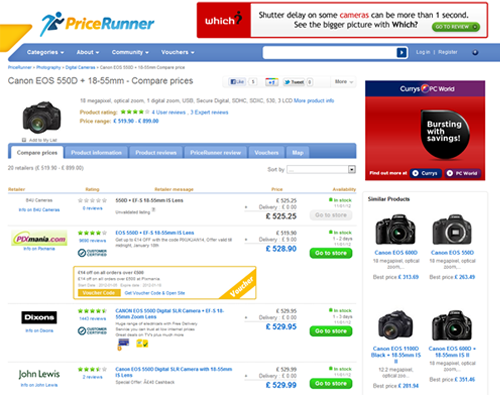
Picture obtained from
http://www.pricerunner.co.uk/
 Comparison websites have great potential for the developments of online shopping: they help consumers in saving time and making informed choices. However, according to a recent BEUC position paper, for their potential to be appropriately developed, they need to be reliable. This means, that they have to be as transparent as possible as to a variety of factors, such as:
-          The ownership;
-          The way they are financed;
-          The frequency with which they are updated;
-          Their geographic coverage;
-          The methodology they employ;
-          Their coverage of the concerned sector (all providers, some providers…).
The provision of this fundamental information, in any case, should not turn into an overload for the users, thus emphasis should be put on the quality of this information, i.e. on the interest which the latter carries for consumers (the price shown, for instance, should be as “final” as possible), without  highlighting price at the expenses of other conditions which consumers should also be aware of. At the same time, the way the information is organised is important: comparability should be granted according to all relevant product characteristics, including delivery. In case of ranking, the consumer should know what factors shape it in order to assess its reliability.
Finally, supervisory authorities should take charge of monitoring comparison activities to ensure consumer trust.