Showing posts with label digital market. Show all posts

Monday, 28 November 2022

EU Commission consultation on digital fairness

The Commission has just announced a public consultation on digital fairness. The intitative comes within the New Consumer Agenda and it aims to analyse whether additional action is needed to ensure an equal level of fairness online and offline.

This fitness check (evaluation) will look at the following pieces of EU consumer protection legislation to determine whether they ensure a high level of protection in the digital environment:

  • the Unfair Commercial Practices Directive 2005/29/EC
  • the Consumer Rights Directive 2011/83/EU
  • the Unfair Contract Terms Directive 93/13/EEC

All stakeholders are invited to respond until 20 February 2023.

Tuesday, 26 January 2021

Norwegian Consumer Council - sheriff of online consumer protection

The Norwegian Consumer Council (Forbrukerrådet) has published two interesting news reports this month. 
 
First, on Jan 14 it has reported on potentially unfair commercial practices of Amazon, which make it difficult for consumers to cancel their Amazon Prime subscription (You can log out, but you can never leave). The Norwegian Consumer Council identified many of these practices as Amazon using dark patterns to manipulate consumers online, hindering them in making informed choices, trying to nudge them away from actually cancelling the subscription (by misdirection, visual interferences, confirmshaming). This may be achieved through making consumers go through many pages, asking them to confirm their choices in a manner that causes confusion with consumers, etc. Generally, the Norwegian survey looked into practices of digital service providers, where consumers would take out a subscription for services. Such subscriptions involve automatic payments, content is delivered online, and thus if consumers stop using a service they may forget about it, it becomes invisible to them. Therefore, it may be especially important to facilitate consumers' termination of such services. And yet, the survey found that 25% of respondents have experienced problems with cancelling such subscriptions due to a difficult process having been set up.

Today, it has reported that another Norwegian authority - Norwegian Data Protection Authority (Datatilsynet) - issued a fine of over 9.5 million Euro to the dating app Grindr (10% of their global annual revenue), following on the Norwegian Consumer Council's complaint from a year ago about infringements of privacy by this app (Historic victory for privacy as dating app receives gigantic fine). The breach of GDPR occurred due to the app collecting and sharing personal data without sufficiently informed and explicit users' permission to such practices (more in the report 'Out of control', on Grindr specifically as of p. 72).

Tuesday, 15 December 2020

Who is on the nice or naughty list?: Digital Markets Act and Digital Services Act

European Commission published today two potentially game-changing proposals for the digital market: Digital Services Act (see here) and Digital Markets Act (see here). For those of our readers who have not heard about the works on the proposals for these two regulations, the Digital Services Act aims to 'comprehensively' regulate the obligations of digital service providers towards users of their services as well as enforcement authorities, whilst the Digital Markets Act sets out the rules for the digital market, e.g. defining its largest participants as so-called 'gatekeepers' and providing for additional obligations for them. These proposals will now be discussed further by the European Parliament and the Council. Below we provide a summary of the proposals.

Digital Markets Act

The advantage of the Digital Markets Act for consumers lies definitely in the environment this regulation aims to promote: more competitive, encouraging consumers to seek for, access and conclude the best possible deal, not locking them into digital services contracts they conclude. The gatekeepers to the market are companies located anywhere in the world, provided they offer their core platform services to business users in the EU or end users in the EU (Article 1(2)). The end users do not have to be consumers (Article 2(16)) as they may be legal persons, as well as natural persons.

Core platform services could be (Article 2(2)): online intermediation services, online search engines, online social networking services, vide-sharing platform services, number-independent interpersonal communication services, operating systems, cloud computing services, advertising services. 

Gatekeepers are defined (Article 3) as providers of core platform services who have a significant impact on the internal market (e.g. annual EEA turnover exceeds EUR 6.5 billion in the last 3 financial years and they provide the core platform service in min 3 Member States), operate a core platform service which serves as an important gateway for business users to reach end users (e.g. more than 45 million monthly active end users located in the EU and more than 10.000 yearly active business users established in the EU), and enjoy an entrenched and durable position in its operations (or could do so) (e.g. where it was an important gateway for the last 3 financial years). These thresholds are just an example, as the Commission has the power to designate other providers as gatekeepers (Article 3(6)). Generally, it is the gatekeeper who should notify the Commission that they have reached such a position (Article 3(3)).

Articles 5 and 6 specify the main obligations of the gatekeepers. These seem to focus on: limiting the scope in which platforms use personal data, not limiting a possibility for business users to offer the same products or services to end users on different platforms under different conditions, not restricting communication of business and end users outside the platform, allowing end users to un-install any pre-installed software applications on the platform, as well as facilitate installation of third party software applications, not prioritise in ranking products or services offered by the gatekeeper, limit bundling of services, facilitate switching of services, transparency obligations.

Further provisions of the proposal for this regulation are devoted mainly to various monitoring obligations, review processes and consequences for non-compliance (mainly fines).

Digital Services Act 

The main advertised advantage of this act for consumers is that the provisions of the regulation will offer them 'more choice, lower prices', 'less exposure to illegal content' and 'better protection of fundamental rights' (see here). These benefits are to result if the aims of the Regulation as defined in its Article 1(2) are achieved. Similarly to DMA this Act also will apply to providers of intermediary services regardless of their place of establishment, as long as the services are provided to recipients established or located in the EU (Article 1(3)). A recipient of the service again does not need to be a consumer, as it may be a legal person (Article 2(b)).

The obligations imposed by this Act are to bind providers of intermediary information society services (Article 2(f)), that is services where providers are either a: 'mere conduit' (transmitters of information provided by recipients or providing access to the communication network, e.g. Internet access providers), 'caching' service (where they temporarily store the transmitted information to make its transmission more efficient), 'hosting' service (where they store the information provided for and as requested by the recipient of the service, e.g. cloud services).

Articles 3-5 specify when providers of various information society services in the above-mentioned categories may be exempted from the liability for the content of that information, i.e. when it is illegal content. These provisions aim then to ensure that consumers (citizens) are indeed exposed to less illegal content (will they suffice? that is the question that goes beyond providing a short summary here!).

Importantly, if a provider conducts a voluntary own-initiative investigation that does not change the status of their exemption from the liability as determined in Articles 3-5 (Article 6). Thus self-checks are to be encouraged. However, there remains no general obligation to monitor the information which providers transmit or store (Article 7), similarly to the current E-Commerce Directive provision.

Articles 8-9 regulate how providers are to comply with orders about removing illegal content and providing information about users, respectively.

Other interesting for us provision may be:

- Article 12 - which obliges providers to transparently outline any content moderation procedures and tools in their terms and conditions;

-  Article 13 - requiring providers to publish an annual report on past year's content moderation; Article 23  adds also an obligation to provide reports on the number of disputes submitted to ADR, number of suspensions (Art 20) and any use of automatic means for the purpose of content moderation;

- Article 14 - providers of hosting services are required to facilitate users notifying them about illegal content and allowing them to act upon such notifications (notice and action);

- Article 15 - requires hosting services providers to notify, in a reasoned and transparent manner, users if their content is removed/disabled/etc as illegal;

- Article 17 - sets out rules on an internal complaint-handling system for online platforms, which they are to provide to recipients of services for min 6 months following either removal or disabling of access to the information provided by recipients, suspension or termination of the service, suspension or termination of the account;

- Article 17(4) and Article 18 - recipients of services should be informed about and have access to ADR;

- Article 19 - specifies rules for processing of notifications of trusted flaggers;

- Article 20 - determines when providers could suspend users' accounts due to misuse, i.e. frequent posting of illegal content;

- Article 22 - specifies that online platforms are required to obtain information from traders allowing to trace identity and location of such traders and should check the reliability of this information;

-  Article 24 - online advertising has to be clearly displayed as such, together with parameters used to determine the recipient to whom the advertisement is displayed;

- Articles 26-33 - contain obligations for very large online platforms, in the same categories as described above, but with stricter provisions.

Further provisions pertain to various enforcement and penalties issues, as well as the plans to encourage adoption of standards and codes of conduct.

Monday, 30 November 2020

New Digital Markets Unit in the UK - putting (some/few) platforms on notice

Another interesting piece of news from the past few days is the UK government announcing the setting up of the Digital Markets Unit ('New competition regime for tech giants to give consumers more choice and control over their data, and ensure businesses are fairly treated') within the Competition and Markets Authority (CMA). The Unit's main task will be to introduce and enforce 'a new code to govern the behaviour of platforms that currently dominate the market'. Is the UK attempting to follow the example of the German Federal Cartel Office (Bundeskartellamt) that has been cracking the whip against the potential abuses of the dominant position on the market of such digital service providers like Facebook (see The Facebook Decision: First Thoughts by Podszun)?

Perhaps, the government's announcement draws attention to the risks associated with the concentration of power in the tech sector, bluntly giving notice to the dominant players on the digital marketplace that they will be under enhanced surveillance in the foreseeable future. They will be expected to follow the new rules for behaviour set out in the code, which will likely require more transparency (as to the use of consumer data?), opt-in options for personalised advertising (the issue that was at play in the German Facebook case), facilitating users' swapping to use any rival platforms.

The DMU is to start their work in April and is supposed to be able to 'suspend, block and reverse decision of tech giants, order them to take certain actions to achieve compliance with the code, and impose financial penalties for non-compliance'. What is of interest to us, of course, is to what extent this new unit will be able to benefit consumer protection in the UK? This is uncertain at the moment, but it seems that any consumer protection benefits may be coincidental rather than intentional here. First, the Guardian reported that the new unit will have oversight only over platforms funded by digital advertising and having 'strategic market status' (Digital Market Unit: what powers will new UK tech regulator have?). This would limit the unit's purview, possibly even only to Facebook's and Google's activities. Second, the DMU will focus on preventing damage to news media... which suggests that the interests of UK news outlets may play out more centrally, over consumers' interests.

A lot will depend on the new code of conduct set by/for the DMU. We will then definitely let our readers know when the new code for the behaviour of these digital platforms is adopted!

Thursday, 14 June 2018

Sweep of telecommunication and other digital services websites

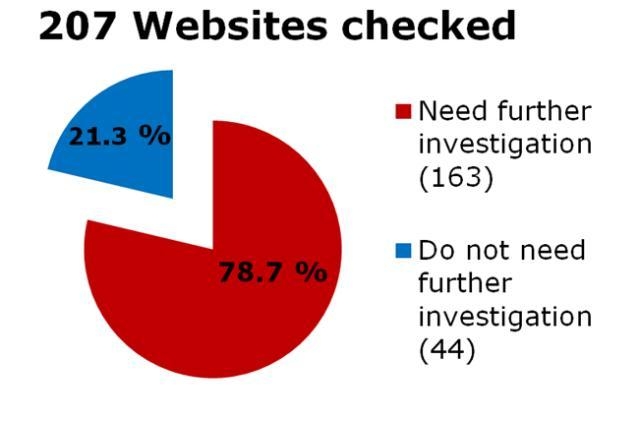
On May 18 the European Commission and national consumer protection authorities published their new sweep report revealing misleading commercial practices adopted by websites offering telecommunication (e.g. fixed/mobile phone, internet) and other digital services (e.g. streaming) (see more Buying telecom services online...). Out of 207 screened websites - 163 could be currently infringing EU consumer law. The most common suspicious practices concerned: 
  • incorrectly advertising certain packages as free or discounted, as in fact these belonged to a bundled offer; 
  • not offering a dispute resolution system (or link to ODR); 
  • maintaining a possibility of unilateral change of T&Cs without adhering to rules on notification or providing a justification;
  • providing incorrect or misleading information on refunds in case of either withdrawal from the contract or non-conformity;
  • automatic contract renewals without properly informing consumers about this.

pie
From the EU Commission website

Saturday, 14 April 2018

New Deal for Consumers: proposals on online transparency

In our earlier post we reported on the behavioural study on transparency of online platforms published by the Commission as part of its „New Deal for Consumers” package. We noted that it is hard not to agree with the general recommendations arising from the study (following up on the earlier documents published as part of the Fitness Check of the European consumer acquis and evaluation of the Consumer Rights Directive); however, for them to actually work in practice a number of detailed issues needed to be solved. Interestingly, several matters of relevance to online transparency addressed in the study have already found their way to the legislative proposals tabled on Tuesday. Should we praise the Commission for this pace of action? Let’s have a closer look at these elements of the “New Deal”.

Legislative package: basic facts

The legislative part of the “New Deal for Consumers” consists of the following two proposals:
  • a proposed directive amending Directive 93/13/EEC (unfair terms), Directive 98/6/EC (price indication), Directive 2005/29/EC (unfair business-to-consumer commercial practices) and Directive 2011/83/EU (consumer rights) as regards better enforcement and modernisation of EU consumer protection rules (COM(2018) 185 final)
  • a proposed directive on representative actions for the protection of the collective interests of consumers, and repealing Directive 2009/22/EC (injunctions) (COM(2018) 184 final) – to which a separate blog post will be devoted.
It is particularly the former proposal in which the new provisions regarding the “digital” sphere are contained  – mainly in the form of amendments to Directives 2005/29/EC (UCPD) and 2011/83/EU (CRD). 

As regards the transparency of online transactions, the proposed amendments affect two of the three dimensions of transparency addressed in the behavioural study: 1) the criteria for ranking and the presentational features of search results and 2) presenting the identity of contractual parties. By contrast, proposals on quality controls for consumer reviews and ratings appear to be missing.

Amendments to the UCPD

One of the ways in which the Commission plans to improve transparency of search results is via the amendment of No. 11 of Annex I to the UCPD. Acording to the new wording

11. Using editorial content in the media, or providing information to a consumer’s online search query, to promote a product where a trader has paid for the promotion without making that clear in the content or search results or by images or sounds clearly identifiable by the consumer (advertorial; paid placement or paid inclusion)

Search results marked as "Ads" on Google
would be qualified as one of the commercial practices considered to be unfair in all circumstances. This does not seem to effect a major change to the state of affairs as, indeed, the providers of leading search tools already identify paid results as such. It should be observed that the proposal does not contain any reference to factors other than direct payment which could have an impact of the placement of a search result such as corporate ties between the operator of a search engine and the supplier of the product or service.

Amendments to the CRD

While the adjustments made in the UCPD would apply to any provider of an online search tool, the amendments made to the CRD with respect to the ranking of offers and identity of contracting parties are essentially limited to "online marketplaces". The latter are defined in the proposed Artice 2(19) as "service providers which allow consumers to conclude online contracts with traders and consumers on the online marketplace’s online interface". This invites several comments.

First of all, while the Commission presents its definition of an online marketplace as "future-proof" this does not necessarily mean that it is free from doubts. Indeed, unlike definitions found in Directive 2011/83/EU on consumer ADR and in Regulation 524/201342 on consumer ODR, the new wording does not refer to a "website", but makes use of a more technologically neutral notion of an "online interface", defined by reference to the newly adopted Regulation 2018/302 on geo-blocking. At the same time, however, the proposed act does not seek to amend Article 7(3) of the CRD which refers to a "trading website". 

Secondly, the decisive function of an "online marketplace" consists in "allowing consumers to conclude online contracts on the online marketplace’s online interface". This seems to suggest that a service provider only qulifies as an online marketplace if the actual contract is concluded by means of the software  provided (website, mobile app), thus excluding webites which merely identify the relevant customers and suppliers.

Thirdly, the definition of an online marketplace refers to the contract concluded by consumers "with traders and consumers". This seems to put an end to a debate whether something like a "consumer-to-consumer contract" can exist. The relevant debate, however, is not limited to the question whether someone who actually sells a good or provides a service can be called a "consumer". This seemingly minor change in wording might also be difficult to reconcile with some national provisions in which a consumer status is intrinsically linked to the professional capacity of his counter-party (see, for example, Article 22[1] of the Polish Civil Code). 

The specific transparency provisions for online marketplaces are found in the proposed Article 6a of the CRD. According to this provision: 

Before a consumer is bound by a distance contract, or any corresponding offer, on an online marketplace, the online marketplace shall in addition provide the following information:
(a) the main parameters determining ranking of offers presented to the consumer as result of his search query on the online marketplace;
(b) whether the third party offering the goods, services or digital content is a trader or not, on the basis of the declaration of that third party to the online marketplace;
(c) whether consumer rights stemming from Union consumer legislation apply or not to the contract concluded; and 
(d) where the contract is concluded with a trader, which trader is responsible for ensuring the application of consumer rights stemming from Union consumer legislation in relation to the contract. This requirement is without prejudice to the responsibility that the online marketplace may have or may assume with regard to specific elements of the contract.

Concluding thought

Improving online transprency clearly belongs to the rationale of legislative proposals submitted by the Commission earlier this week. The specific proposals made promise to bring more clarity to consumers, but do not address all the identified problems. If the proposed directive was to be adopted in the current form, a further question might be asked as to the extent to which Member States could still intervene in ensure transparency of online platforms (considering the full harmonisation nature of both the UCPD and the CRD). The current wording of the proposals also leaves a range of interpretative questions open. Should these not be addressed in the legislative process, this important task will, once again, be left to the Court of Justice. 

Wednesday, 29 November 2017

Temptation of subscriptions

In the UK the organisation Citizens Advice conducted a study of consumers subscribing to various services and discovered that on average consumers pay ca 160GBP over a period of three months for unwanted services. These would include subscriptions to gyms, insurance, online streaming, TV channels - that would not end up being used. The message to consumers is to be aware of their usage habits and not to be too easily tempted to conclude yet another service at a seemingly attractive price, with an easy subscription process. Reading contract terms before signing up is always a good idea. A simple subscription process makes consumers easily sign in, but the sign-out process may be more complex and conditional. Citizens Advice reports on 9 out of 10 consumers being initially refused cancellation, in practice. This indicates the need for more inquiry into the terms and conditions of these services providers and the fairness of their provisions on terminating the contract. Still, even if termination is possible, consumer behaviour biases mean we tend to overestimate our future behaviour (how many times we will make use of the gym subscription, for example) and may be unlikely to timely cancel a contract we don't benefit from. An attractive price still may mean paying money for something that we end up not using at all, which profits service providers not consumers. 

Wednesday, 30 March 2016

First data on geo-blocking practices in the e-commerce sector published

On 18.3.2016 the European Commission (DG COMP) published an issues paper presenting its initial findings on geo-blocking practices in the e-commerce sector. The sector inquiry conducted by Directorate-General for Competition is a part of a wider initiative on geo-blocking, which was already announced in the last year's communication on Digital Single Market

The recently published document is based on responses of more than 1400 companies involved in online sales of consumer goods and in the supply of digital content. Nearly three quarters of replies come from online retailers. Questionnaires were also sent to operators of online marketplaces, price comparison tools and payment systems. Data obtained from digital content providers (broadcasters, electronic communications companies) were analysed separately. 

For purposes of the study, geo-blocking is interpreted broadly and refers to "commercial practices whereby online providers prevent users from accessing and purchasing consumer goods/digital content services offered on their website based on the location of the user in a Member State different from that of the provider". It can take a variety of forms such as "(i) preventing the user from accessing the website, (ii) automatically re-routing the user to another website, (iii) refusing payment or (iv) refusing delivery". However, it does not include geo-filtering, which consists in "offering different terms and/or conditions depending on the location of the user".

Initial findings reveal significant differences with regard to consumer goods and online digital content. In online sales of tangible goods geo-blocking appears to be less widespread and usually stems from a unilateral business decision. According to respondents, geo-blocking in this field is mostly manifested by a refusal to deliver abroad. Conversely, complete denial of access to digital content based on IP verification is by no means unheard of, and is often required contractually. However, it is important to note that most restrictions in this field are imposed in licensing agreements with right holders and therefore cannot be regarded as illegitimate per se.

The discussed issues paper only gives a partial picture of the ongoing sector inquiry and we still have to wait at least a couple of months for a more detailed analysis in the preliminary (mid-2016) and final report (early 2017). It goes without saying that the current wording warrants further elaboration. The part on digital content only deals with audio-visual and music content, while computer games, software and books (including e-books) are analysed in the chapter on consumer goods. Reasons for such a differentiation are not explained, though. The interface between competition law and intellectual property also deserves a more in-depth evaluation. Judging by the cautious wording of the present document, spectacular antitrust interventions in the field of digital content do not seem very likely. At the same time, it is to be expected that the e-commerce inquiry will constitute a source of information for other Directorates-General, which are currently working on a legislative proposal on geo-blocking (scheduled for mid-2016). There seem to be a common understanding that the principle of non-discrimination laid down in Article 20 of the Services Directive does not offer consumers an effective tool of protection and is barely enforced in practice (see e.g. BEUC response to public consultations)Be it as it may, developing an adequate policy solution is a challenging task, which requires a careful examination of numerous subtle interconnections with existing and upcoming legislation. It remains to be seen if the broad approach, apparently favoured by the Commission, will allow to strike a fair balance between the competing interests involved. How the subject of copyrighted digital content will be addressed in the geo-blocking proposal is one of many interesting questions to follow.

Tuesday, 8 March 2016

Press digest

Press digest


Sharing economy

Euractive reports (see here) that the European Commission delayed the publication of its guidelines on sharing economy from March until mid-2016. The guidelines are expected to clarify the legal position of the online platforms and the scope of application of the Services Directive, the E-Commerce Directive and consumer acquis. The legal position of online platforms is also currently being evaluated by the CJEU in two cases concerning Uber (see C-434/15 and C-526/15).

Social Media

Facebook is under investigation in Germany for the potential abuse of its dominant position in the social networking area that would consist of gathering excessive amount of data from its users, without giving them a choice to use the service otherwise (see here and here). The standard terms and conditions of Facebook could thus also be challenged, in this respect, as unfair.

Also Tinder's practices have been questioned by consumer organizations, in countries such as Norway, Slovenia, the Netherlands. Tinder's T&Cs reserve the right for the company to repurpose user-generated data even after the account is deactivated (permanent deletion is impossible!) by the user. This data could include even personal photos. Other terms in the Tinder's T&Cs would also fail the unfairness test under the Unfair Contract Terms Directive (e.g. setting the US Texas law as the applicable law). (see here)

Healthy food

At a conference in Amsterdam, most MS and some stakeholders agreed to work together to further reduce salt, saturated fat and sugar content in food products (see here).

Within the EU Parliament MEPs have endorsed in the plenary new fruit and milk scheme. The existing milk scheme for schools will be enriched by new rules on fruit and vegetable. The aim is to increase school children access to fresh products, as well as to improve their education on healthy eating (see here).

Thursday, 10 December 2015

Commission's proposal on the Digital Single Market out

Yesterday, the European Commission published two proposals aimed at harmonising the rules on two aspect of digital economies: sales of goods and provision of so-called digital content. There will be chances to discuss the proposals more in detail in the weeks and months to come (in particular: to what extent can they still be considered as a legacy of the discarded common sales law proposal?). Curious readers, however, will find them on the website of DG justice, accompanied by a number of context documents as well as country factsheets. Exciting times!

Wednesday, 2 September 2015

Survey on cross-border access to online content

The European Commission has published a new Flash Eurobarometer 411 with results of a survey on "Cross-border access to online content". The survey examines with what frequency EU citizens access the Internet (it's least used in Romania, Bulgaria and Portugal) and through what media (portable devices are generally more popular than desktop computers and unsurprisingly, the younger the respondent the more likely he is to use a smartphone to access the Internet) and if they do, then whether they also access digital content online, what types thereof (music and audio-video content is the most popular, while e-books remain quite unpopular - but that may also depend on fact that e-books are mostly mentioned as paid digital content, while music and audio-video content is offered accessed for free). The reasons for not accessing digital content online are also explored (no interest, other access means than digital more attractive, lack of knowledge). With regard to the cross-border options, the study checks the willingness of EU citizens to purchase online digital content in a different than their own language (the majority only accesses it if it's in their country's language), as well as whether they are willing to purchase such content from providers from other Member States and what problems they might have experienced with regard to such purchases (in only half of reported cases EU citizens had no problems accessing digital content generally meant for users of another country).

Friday, 10 April 2015

Digital Single Market: equal pricing across the EU and ban of geo-blocking

Many consumers are nowadays aware that they may purchase the same product online from the same trader at a different price in various countries. For example, purchasing flights from Amsterdam to Warsaw could be more expensive than flights from Warsaw to Amsterdam; the same dress sold on the Dutch website of an international clothing designer could be more expensive than on their English website. This difference in pricing could hinder further development of a Single Digital Market and therefore, the investigation into the reasons for it and its functioning has been announced by the European competition commissioner, Margrethe Vestager (Competition policy for the Digital Single Market: Focus on e-commerce). Another issue that will be looked into are the geo-blocking software that enables certain service providers to limit provision of their services to certain countries only. For example, if you log in with your account to Netflix in the Netherlands you will access different movie library than in the United States or in the United Kingdom, mostly due to film and TV rights-holders increasing their own income by selling these rights at a different price for various countries; YouTube will not show a certain video to you based on your geographical location (EU plans competition inquiry into e-commerce sector; Europe wants to stop geo-blocking on Netflix and RTE). Vestager said in her speech: “(...) consumers must be allowed to look for the best deals online wherever they want. Contractual bans of so-called passive online sales are therefore considered hardcore restrictions of competition.

Wednesday, 18 February 2015

New digital single market strategy expected to kick off next May

Yesterday, the EU Parliament Magazine recapped the priorities announced by the two Commissioners in charge of the Digital Single Market, Andrus Ansip and Günther Oettinger. 

What we can extrapolate from the series of statements is that the Commission will start with a proposal to "modernise" existing copyright rules (modernisation which, indeed, many stakeholders invoke), to then move to telecoms and audiovisuals. Less specific undertakings concern search engines and the digitalisation of public administrations, while a last topic-"striking the right balance between keeping the internet open as a forum  for freedom of expression, while also making sure it is not abused as a vehicle to fuel hatred"- might be more contentious, especially since its pertinence to the digital single market agenda seems questionable. 
The article highlights how the two Commissioners expect the Parliament to cooperate with the effort; while the latter, however, emphasises the need to concentrate on "supporting consumers rights" in the digital marketplace, the Commissioners seem more concerned with the establishment or improvement of market conditions in the first place- a difference in vision that might make cooperation less smooth on given occasion. 
Of course, we will know more after May, when the copyright proposal will be presented. 

Tuesday, 18 December 2012

Digital Consumers and the Law

A nice thing about the week before the holidays is that usually a lot of packages arrive. The one I just opened contained a new book on 'Digital Consumers and the Law', resulting from a joint project of the Amsterdam Institute for Information Law (IViR) and the Centre for the Study of European Contract Law (CSECL).

The book deals with the following topics: 

Chapter 1 Digital Content Markets for Consumers: Characteristics, Challenges, and Legal Context.
Chapter 2 Classifying Digital Content: Good, Service or Else?. 
Chapter 3 Somewhere between ‘B’ and ‘C’: The Legal Status of the ‘Prosumer’ in European Consumer Laws. 
Chapter 4 Pre-contractual Information Requirements for Digital Content.  
Chapter 5 Conformity and Non-conformity of Digital Content. 
Chapter 6 Educating the Regulator: A More Mature Approach Towards the Underage Consumer.
Chapter 7 Fundamental Rights and Digital Content Contracts.  
Chapter 8 Money Does Not Grow on Trees, It Grows on People: Towards a Model of Privacy as Virtue.  
Chapter 9 Conclusions.

Please refer to the publisher's website for more information.

Copyright in the digital market

Secondly, the Commission adopted a communication on copyright today, which presents points of action to keep the EU's copyright framework fit for purpose in the digital environment. The Commission's plans comprise the following:

'A structured stakeholder dialogue, jointly led by Commissioners Michel Barnier (Internal Market and Services), Neelie Kroes (Digital Agenda) and Androulla Vassiliou (Education, Culture, Multilingualism and Youth), will be launched in 2013 to seek to deliver rapid progress in four areas through practical industry-led solutions.

These areas are cross-border access and the portability of services; user-generated content and licensing for small-scale users of protected material; facilitating the deposit and online accessibility of films in the EU; and promoting efficient text and data mining for scientific research purposes.

In parallel, the on-going review of the EU framework for copyright legal will be completed, based on market studies, impact assessment and legal drafting work, with a view to a decision in 2014 on whether to table legislative reform proposals.'

Please refer to the press release and website for more information.

Wednesday, 5 December 2012

Do you copy that? - BEUC's new copyright strategy

In particular in the digital environment, consumers are more and more often facing questions concerning copyright. As the European consumer organisation BEUC puts it in a letter to European Commission President Barroso:

'From the consumers’ point of view, the current copyright framework is far from balanced. In many Member States, copyright law makes the everyday activities of consumers, such as backing up and copying legally bought music, films and e-books in order to play on a different device, illegal. Under current laws, parodies and pastiches which have gained new cultural relevance in the digital ‘mash up’ culture are illegal.'

According to BEUC, the current legal framework regarding consumers' use of copyright protected material is outdated, since it does not sufficiently take into account consumer expectations and the public interest. For that reason, BEUC has now published a Copyright Strategy, which lists specific action points for specific problems on the intersection of consumer law and copyright law. 

As regards consumer rights, BEUC's main suggestions are to:
• Recognise consumers as a key stakeholder in debates and discussions surrounding copyright law on equal footing as creators and copyright users;
• Assess the effectiveness of the current copyright law from the consumers’ perspective;
• Strike a balance by recognising a set of clear, comprehensive and absolute consumers’ rights;
• Revise the Copyright Directive 2001/29 with the aim of establishing a flexible, future-proof and consumer-friendly copyright law;
• Replace the current system of copyright exceptions and limitations with a system of user’s rights.

Wednesday, 11 January 2012

Pursuing the Digital Agenda - the Commission's e-Commerce Action Plan and Green Paper

As promised, here is some more news on the European Commission's initiatives for the digital market: Today, the Commission presented its Action Plan on e-commerce and other online services, aimed at building trust in the digital single market. The Action Plan forms part of the measures that were announced in the Digital Agenda and Single Market Act. The Commission expects that enhancing trust in the digital market will benefit different groups of stakeholders, including consumers (p 3):

'More e-commerce will generate tangible benefits for consumers such as lower prices, more choice and better quality of goods and services, thanks to cross-border trade and easier comparison of offers. The overall gain for consumers would be around EUR 204 billion (1.7% of European GDP) if e-commerce reached 15% of retail sales and if the obstacles to the Single Market were removed. Vulnerable people (the elderly, those with reduced mobility, those isolated in rural areas, those with low purchasing power) will particularly benefit and Europe will thus be better placed to meet the demographic challenges of today.'

The Action Plan is aimed at removing the following obstacles to the digital market (p 4):
'- the supply of legal, cross-border online services is still inadequate;
- there is not enough information for online service operators or protection for internet users;
- payment and delivery systems are still inadequate;
- there are too many cases of abuse and disputes that are difficult to settle;
- insufficient use is made of high-speed communication networks and hi-tech solutions.'

Accordingly, the Commission sets five priorities (p 5 ff):
'- develop the legal and cross-border offer of online products and services;
- improve operator information and consumer protection;
- reliable and efficient payment and delivery systems;
- combating abuse and resolving disputes more effectively;
- deploy high-speed networks and advanced technological solutions.'

More information is available in the Commission's press release (in French), in the Q&A section and on Vice-President Neelie Kroes' blog.

Together with the Action Plan, a Green Paper was presented on card, internet and mobile payments. The Green Paper initiates a consultation period, running till 11 April 2012, during which the Commission seeks to obtain the views of stakeholders on enhancing the possibilities to make online payments. The aim is to create 'a secure and transparent integrated payments environment throughout the EU'.

See also the press release and Q&A page.

Tuesday, 10 January 2012

Sweep(ing) results

Any idea what are the costs of borrowing some money online? This is not supposed to be a trick question, but it turns out that some credit suppliers are making it more difficult for consumers to understand their conditions than others... This becomes clear when looking at the results of the EU investigation of consumer credit websites that the European Commission published today. The so-called 'Consumer Credit Sweep' took place in September 2011 and was carried out by national enforcement authorities who conducted simultaneous, coordinated checks for breaches in consumer credit law. The sweep operation focused on the way in which businesses apply the Consumer Credit Directive, as implemented in the laws of the Member States. In particular, it was investigated whether consumers received the information to which they are entitled under EU consumer law before signing a consumer credit contract.

A quick look at the results: No less than 70% of the 393 investigated websites were flagged for further investigation. The main topics of concern were:
- the advertising did not include the required standard information;
- the offers omitted key information that is essential for making a decision;
- the costs were presented in a misleading way.

As a follow-up to this Sweep, the European Commission indicates that '[n]ational enforcement authorities will now contact financial institutions and credit intermediaries about suspected irregularities and ask them to clarify or take corrective action. ... Failure to do so, depending on the national legislation which is applicable, can result in legal action leading to fines or even closure of the websites.'

A press release and Q&A page can be found on the Commission's website.

More news on the Digital Market, in the form of a Green Paper and Action Plan, is expected tomorrow (as announced last week).