Showing posts with label internal market. Show all posts

Friday, 4 September 2020

Roam like at home default for all - CJEU in C-539/19

Dear readers, 

as you may have suspected already, the CJEU went back in session this past week and delivered a good number of judgments and opinions of interest to consumer law aficionados. While other cases may deserve complex scrutiny, hereby a short notice on a less complicated, but still somewhat impactful, decision: Verbraucherzentrale Bundesverband v Telefónica Germany.

The case concerns the interpretation of Regulation 2015/ which introduced "Roam like at home" (RLAH) as the rule within Europe, effectively ending roaming charges in the EU for most telecom customers. Unlike other companies, Telefonica Germany (OZ) had not immediately transferred all its customers to a RLAH regime on the day (15 June 2017) the regime was supposed to enter into effect. In particular, customers who, prior to that date, had acquired a special roaming package with the company were not automatically transferred: instead, they were asked to opt in for RLAH - lacking such express action, their previous contractual conditions were kept in place. 

Offering specific roaming packages tailoring to the needs of particular groups of consumers is allowed after 15 June 2017 under art 6e(3) of the regulation, providing that  roaming providers may offer, and roaming customers may deliberately choose, a roaming tariff other than the one offered under RLAH terms. 

In practice, Telefonica maintained that an invite to customers to opt in RLAH was enough to guarantee that staying with the alternative tariff was a deliberate choice as required by the provision; the Verbraucherzentrale disagreed and the CJEU concurred in such disagreement. 

The court considered the possible advantages and disadvantages of opt-in and opt-out for introducing RLAH and concluded that nothing - from the letter of the regulation to the intention of abolishing roaming charges - could be read to suggest an interpretation of deliberately not requiring RLAH to be the default option in case of consumer inaction. 

The fact that no AG opinion was submitted on this case suggests not many sleepless nights were required to reach this conclusion, which may or may not open a complicated file for Telefonica: since the original proceedings were an injunction against the company's implementation of the Regulation, it is unclear whether other remedies will be sought. 

Wednesday, 20 January 2016

A look into the future: What does 2016 hold for consumer law?

There is no doubt that 2015 was quite a busy year for the European institutions. In the light of considerable social, economical and political challenges faced by the EU these days, the European Commission under the presidency of Jean-Claude Juncker proclaimed that it would carefully choose its priorities and focus on feasible initiatives. While it is still too early to predict whether this approach will go beyond mere declarations, an overall policy stance can already be inferred from first two work programmes published under rather high-sounding titles: A New Start and No time for business as usual. Key objectives within ten priority areas have been defined and measures to be taken in order to reach them were announced. But what does this actually mean for consumers?

From the consumer law perspective three areas deserve particular attention:
  • Measures designed to create a connected Digital Single Market
  • Initiatives aimed to further deepen the internal market
  • EU international trade policy, especially the Transatlantic Trade and Investment Partnership (TTIP), which is currently being negotiated by the EU and the USA
As we have already reported, first three legislative proposals implementing the Digital Single Market were presented on 9 December 2015. The first one deals with a fully novel issue of digital content (e.g. streaming music, purchasing e-books), while the second one builds upon the existing regulatory framework for online sales of goods. Both measures are seeking to fully harmonise several core aspects of online business-to-consumer sales of tangible goods and supply of digital content, including rules on pre-contractual information duties, consumer’s right to withdraw from the contract, conformity of goods and digital content as well as relevant remedies. Furthermore, a proposal for a regulation on ensuring the cross-border portability of online content services in the internal market was adopted.

In 2016 the Commission will surely try to further proceed with these measures. Its new approach to the European law-making shall ensure that the Digital Single Market strategy does not share the fate of the Common European Sales Law. Efforts are made to secure a common understanding with the European Parliament and the Council on key initiatives already at an early stage. Despite public concerns about the impact of such arrangements on the democratic process, an inter-institutional Agreement on Better Law-making has recently been finalised. Time will tell whether this approach will produce the desired results. In any case, it seems unlikely that the flagship measures implementing the Digital Single Market, which are by no means uncontroversial, will come into force in the nearest months. Also the Dutch Presidency in the Council seems to be taking a ‘wait and see’ attitude to this issue.

2016 will therefore rather be a time of intense discussions, public consultations and further legislative proposals. We may, among other things, expect a proposal aimed to bring an end to unjustified geo-blocking as well as other forms of discrimination on the basis of residence or nationality. Detailed information on the envisaged copyright reform should be presented shortly. Of particular interest are also measures, which have already been adopted in the previous years – such as Regulation 524/2013 on online dispute resolution for consumer disputes – or those at an advanced stage of adoption. It is worth noting that the European ODR platform has lately become operational and will be made available to consumers and traders on 15 February. While a faster and easier, Internet-based mechanism of resolving disputes between consumers and traders sounds like a good idea, much still needs to be done to ensure its reliability and promote its use among both parties to the contract. Furthermore, in the following months we will almost certainly witness a long-awaited reform of EU data protection law. Following the agreement reached in trilogue last month, it appears very likely that the final texts of General Data Protection Regulation and Data Protection Directive will be formally adopted in the first quarter of 2016.

From the consumer law perspective, particular attention should also be paid to the Commission’s Regulatory Fitness and Performance programme (REFIT), i.e. a systematic analysis whether the existing regulatory framework is fit for its purpose. According to the recently published roadmap, a substantial part of EU consumer law will be subject to evaluation within next 18 months, namely:
  • Directive 2005/29/EC concerning unfair business-to-consumer commercial practices in the internal market (Unfair Commercial Practices Directive);
  • Directive 1999/44/EC on certain aspects of the sale of consumer goods and associated guarantees (Sales and Guarantees Directive);
  • Directive 93/13/EEC on unfair terms in consumer contracts (Unfair Contract Terms Directive).
  • Directive 98/6/EC on consumer protection in the indication of the prices of products offered to consumers (Price Indication Directive);
  • Directive 2006/114/EC concerning misleading and comparative advertising (Misleading and Comparative Advertising Directive);
  • Directive 2009/22/EC on injunctions for the protection of consumers' interests (Injunctions Directive).
Additionally, Consumer Rights Directive 2011/83/EU and Regulation 2006/2004 on consumer protection cooperation are also expected to undergo separate evaluations in the coming months. During the first semester of 2016 public consultations on application of consumer legislation in Member States will be launched, which might well be a spark for another heated debate, reminiscent of the time when the Common European Sales Law was still on the agenda.

Without doubt 2016 will be a very exciting year in consumer law. Like every year, we will keep you posted about the most significant developments, so stay tuned!

Monday, 3 March 2014

Harmonisation of insurance contract laws?

Short after the Parliament's first reading vote on the Common European (now, Distance) Sales Law, the Commission might be starting a new contract law harmonisation challenge. 
Last Friday, indeed, the previously appointed Expert Group delivered its report on barriers to cross-border trade in insurance products.
Presenting the report, Commissioner Reding underlined how "only a few customers can buy insurance products in other countries, with just 0.6% of all motor insurance premiums and 2.8% of property insurance premiums offered across EU borders." 
The Group's main finding is that important differences exist in the contract law rules of especially life, motor and liability insurance products, which make it harder- and more expensive- for traders to offer "pan-european" products and for consumers/policyholders to take their insurance with them as they move between European countries. Of course rules outside contract law could also play a role in generating such barriers, but these rules remained beyond the Group's subject of investigation.
Unsurprisingly, the problem is found to be less severe in the large risks segment, where the cross-border dimension has been for a longer time usual business. 
Want to know more? You can take a look at the report.


Tuesday, 18 February 2014

Roaming-free EU telecoms by 2016?

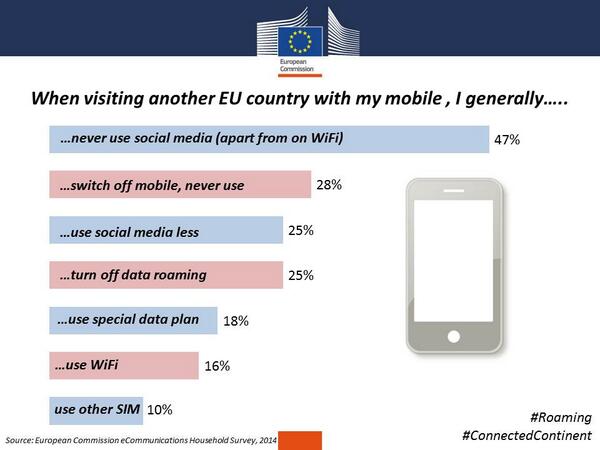
In an effort to back its recent legislative proposal aiming at the establishment of an internal market in the field of telecommunications, the Commission has published a survey concerning the connectivity behaviour of European citizens when travelling across the continent. 

According to the survey (which also provides disaggregated country results), almost all European citizens (94%!) adapt their telecom habits when spending time abroad. This happens to a dramatic extent with regard to mobile internet services, which we simply tend to dispense of when roaming is involved, but "traditional" communications are not spared either (apparently, roughly a quarter of Eu users simply switch their phones off). 

Perhaps not so surprisingly, frequent travellers do not seem more at ease with roaming than occasional ones. To the contrary, experience might make consumers even more cautious, especially as far as data roaming is concerned.

The situation, says Commission's VP Neelie Kroes, doesn't make sense from an economic point of view: if roaming costs disappeared, consumers would simply... well, "consume" more telecom services. Telecom companies, unfortunately, don't seem ready to give up their current gains to invest in this perspective growth. This is why the Commission has repeatedly intervened in the market in introduce "caps" on the prices that companies can charge for roaming services. 

The proposed "Connected continent" regulation would eliminate roaming altogether, creating a real single market for telecoms. This would not only mean that travellers may stop worrying about roaming, but also that consumers in general could pick their operator among all of those operating in Europe, irrespective of where they live. 

Friday, 7 December 2012

8th consumer scoreboard

What markets are working better for EU citizens? And where is there, to put it nicely, larger room for improvement?
Some answers can be found in the latest Consumers Market Scoreboard, which measures consumers overall appreciation of the markets along seven parameters (‘comparability’, ‘trust’, ‘satisfaction’, ‘choice’ and ‘ease of switching’, plus ‘problems’ and ‘complaints’).
In general, it seems that European consumers find themselves relatively at ease within markets for goods- with the notable but unsurprising exception of second-hand cars...
On the other hand, services markets in general seem to cause more troubles. In particular, at the bottom of the chart lay banking sand telecom services, which perform poorly on several parameters.
European consumers seem also to be at strains with energy markets when it comes to important aspects such as choice, comparability and switching suppliers and tariffs.
Finally, the most remarkable decreases in performance seem to have been taken place in the transport and post-delivery markets as an effect of the crisis. The latter has led governments to curb public subsidies to those sectors. 
Another interesting remark is to be found in the Commission's press release: apparently, "[m]arkets are assessed differently by different socio-demographic groups." Further research with the aim of clarifying the reasons for that is promised (and vividly looked forward to by this author).

Thursday, 29 November 2012

Green paper on cross-border parcel delivery

The European Commission has just launched a consultation with stakeholders to collect information on the current state of the delivery markets for products bought online, and to identify any potential hurdles for the creation of an EU-wide integrated parcel delivery market. 
The consultation is open to not only to businesses, but to "virtually everyone who sends or receives parcels". In order to encourage participation of stakeholders (potentially, most of us)respondents do not need to answer every question but can choose the issues that interest them. 
Delivery services are already regulated at the European level, but the concerned legislation was not conceived to explicitly address the modern needs of consumers who buy online.Contributions can be submitted by 15 February 2013. They will later be published on the Commission's website and the Commission will present actions to be taken as "to complete the internal market for parcels". 
For some relevant fats and figures, have a look at the Commission's memo.


Friday, 26 October 2012

Towards removing hurdles to single market

The European Parliament adopted yesterday a non-binding resolution addressing consumers' concerns with regards to the single market. In the resolution the Members of the European Parliament point out specific cases in which the lack of sufficient, uniform protection given to consumers throughout Europe is especially visible (banking services, vehicle registration, recognition of qualifications etc.). See our earlier post on this subject: Addressing consumers' concerns.

Friday, 12 October 2012

European Parliament & the CESL

Exactly one year after the Commission launched its proposal for a Regulation establishing a Common European Sales Law (CESL), yesterday the Economic Affairs committee of the European Parliament decided to support it. 
Meanwhile, the Parliament's Legal Affairs (JURI) and Internal Market (IMCO) Committees are also preparing reports due to be finalised in the coming months. 
This is thus only a first step towards a common EP position on the topic. 
However, the CESL proposal might be consistent with the direction indicated by the Internal Market committee through a non-binding resolution which was also adopted yesterday, urging the Commission to take action in the field of online cross-border trade in order to remove the (material and legal) obstacles which hinder exchanges and growth. Does this make a good auspice for the CESL's destiny? Don't miss the next episodes...