Thursday, 30 August 2012

Spoiled for choice or well-informed?


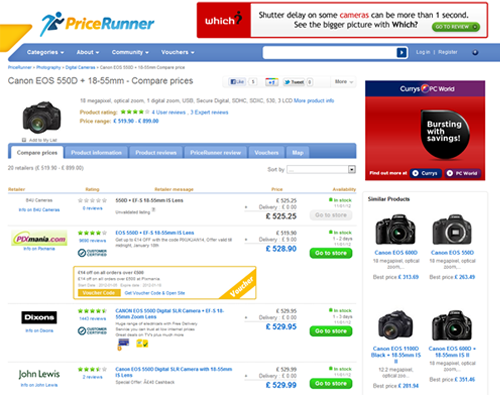
Picture obtained from
http://www.pricerunner.co.uk/
 Comparison websites have great potential for the developments of online shopping: they help consumers in saving time and making informed choices. However, according to a recent BEUC position paper, for their potential to be appropriately developed, they need to be reliable. This means, that they have to be as transparent as possible as to a variety of factors, such as:
-          The ownership;
-          The way they are financed;
-          The frequency with which they are updated;
-          Their geographic coverage;
-          The methodology they employ;
-          Their coverage of the concerned sector (all providers, some providers…).
The provision of this fundamental information, in any case, should not turn into an overload for the users, thus emphasis should be put on the quality of this information, i.e. on the interest which the latter carries for consumers (the price shown, for instance, should be as “final” as possible), without  highlighting price at the expenses of other conditions which consumers should also be aware of. At the same time, the way the information is organised is important: comparability should be granted according to all relevant product characteristics, including delivery. In case of ranking, the consumer should know what factors shape it in order to assess its reliability.
Finally, supervisory authorities should take charge of monitoring comparison activities to ensure consumer trust.

Smart meters

Managing energy consumption in Europe is one of the issues that European Commission is busy with. (Cities getting smart) Since households are responsible for 40% of total energy consumption, educating consumers on smart energy consumption and changing their energy consumption habits plays a significant role in energy policy. One way to change these habits is by installing smart meters in all/most households in Europe. (Smart Grids) What are smart meters?

"Smart meters display household's energy consumption in real-time, giving users the possibility to monitor fluctuations in their energy consumption both locally and remotely – through wireless systems, the internet and smart phones." (Consumers unaware of smart meters ahead of EU-wide roll-out)

The European Commission requires the Member States to submit by 3 September 2012, their cost-benefit analysis on the deployment of smart meters. (Commission recommendation of 9 March 2012) If the analysis is positive, then the Member States should roll-out smart meters to consumers, while European Commission would set European standards on them. By 2020 at least 80% of consumers should be equipped with intelligent metering system.

At this point it seems that consumers are mostly unaware of smart meters. (Research in the UK) Representatives of consumers expressed their doubts as to the benefits of using smart meters for all consumers, since in low-income households the energy consumption is often not able to be further reduced. Therefore, the BEUC does not believe that the use of smart meters should be mandatory. (Empowering consumers through smart metering) Also the EDPS had some issues with the potential infringement of data protection regulations by the use of smart meters. (EDPS' opinion)

Wednesday, 29 August 2012

EU vs. hackers

The European Network and Information Security Agency (ENISA) published this week a report on cyber incidents reporting in the EU. Cyber security incidents often affect millions of citizens, businesses and consumers (e.g., in 2012 millions of business network passwords were exposed through hacking of LinkedIn; in 2011 due to a failure in the UK datacenter millions of users of BlackBerry across the EU and globally could not send or receive emails), but pursuant to the report these incidents are often not reported or even not detected.

Dr Marnix Dekker and Chris Karsberg, the report’s co-authors, argue: “Cyber incidents are most commonly kept secret when discovered, leaving customers and policymakers in the dark about frequency, impact and root causes.” (EU agency ENISA analyses cyber security legislation & spots implementation gaps; incidents remain undetected or not reported)

The study analyses the adopted EU measures on mandatory incident reporting from the Telecom package, e-Privacy Directive as well as the proposed e-ID regulation and the Data Protection reform, showing the differences and commonalities of their provisions and trying to create an overview of the EU cyber security strategy (see: roadmap). Areas for improvement have been identified in the paper, as well. Hopefully, new measures developed by the ENISA, like an incident reporting format will help national regulators to overcome the lack of transparency and increase the amount of information about these incidents. Harmonisaton of these issues is crucial, taking into account that often cyber security incidents taking place in one country impact citizens in other Member States.

Monday, 27 August 2012

Is living longer still worth it?

European consumers shop not only for various goods, but also for services and soon an increase of interest in purchasing new insurance policies among European women is to be expected. Why? As of 21 December 2012, on the basis of the CJEU's judgement in the case Test Achats (the Belgian Consumer Association), the insurers will no longer be able to calculate costs and benefits of insurance based on a person's gender. This gender-neutral pricing is based on the principle of equality expressed in the Gender Directive of 2004 that requires unisex pricing for European consumers. This ruling is, however, to the detriment of European women, who 'traditionally enjoyed cheaper life insurance because of their longer life expectancy'. (EU Directive Could Send Women Running to Buy Life Insurance) Some consumer organisations expect that the insurance premiums for women could rise by a third (Life insurance premiums set to soar). At the same time, certain insurance companies assure that their premiums should not be overly influenced by this ruling (e.g., http://www.aviva.co.uk/gender-neutral-pricing/). It remains to be seen whether these premiums will indeed rise and whether shopping for a cheaper insurance companies will be on many women agendas as of 2013.

Thursday, 23 August 2012

Once upon another time

Times are changing, also in the digital world. An infograph, made by Best Education Sites, gives a nice overview of the development of the Internet over the past 10 years.


Click here for the full graph. For a collection of informative pictures on a variety of topics, see also Infographic Directory.

Wednesday, 22 August 2012

No more logos on cigarette packs in the EU?

It is unlikely that anyone would consider smoking a healthy habit. It still may be seen as a sign of 'being cool', but the times had changed and the Mad Men-era where success was celebrated with a cigarette in one hand is long gone. In more and more Member States a ban has been introduced on smoking in public places. Still, more means on deterring Europeans from smoking are being considered - some of them could further restrict advertising and packaging rules of tobacco products.

The European institutions consider introducing a ban on logos on cigarette packs, for example, within its review of 2001 Tobacco Products Directive, which is to be published in the fall. A spokesman for the European Commission, Antonio Gravili, said during a news briefing that introduction of European rules on plain packaging of tobacco products is being considered. (EU considering cigarette logo ban to deter smoking) Such a ban is already in force in Australia, and as of December all cigarettes sold there will have to be wrapped in plain, olive packaging. This governmental ban was questioned by British American Tobacco, Philip Morris and other tobacco companies but the Australia's High Court upheld the ban. Tobacco companies claim that such a ban infringes their intellectual property rights and boosts sales of fake or illegally imported cigarettes. (WHO welcomes landmark decision from Australia's High Court on tobacco plain packaging act and Australia's plain packaging wins against global tobacco firms)

Other options that are being discussed in the Commission are: printing larger graphic images on cigarette packs of the diseases linked to smoking (though how much larger can it get, really?), covering electronic cigarettes with the Directive.

This all comes among the World Health Organisation's prediction that smoking could kill 8 million people every year by 2030. (WHO report on the global tobacco epidemic - executive summary) Another survey showed that Europe has the world's highest rate of smokers aged 13-15. (Exposure of children to environmental tobacco smoke and Global Youth Tobacco Survey)

Tuesday, 21 August 2012

The architecture of European consumer law

Another addition to the Summer reading list: Hans Micklitz (EUI) published a paper on the architecture of European consumer law and the need for innovation of its structure.

The abstract reads as follows:
'The paper is a translation of the Gutachten prepared for the 69. Deutschen Juristentag to be held in September 2012. It pleads for a separate consumer law code outside private law codifications. The benchmarks are: rethinking the concept of the consumer (the vulnerable consumer and the consumer/customer), focussing beyond traditional consumer law on internet sales and on consumer services (telecom, energy, transport, financial services), integrating and developing a consistent approach to consumer law enforcement via individual and collective action, via ADR, courts and administrative bodies. The solution is seen in a movable system (bewegliches System) that allows for connecting substantive rights and remedies to the different concepts of consumers, vulnerable, confident and responsible.'

The paper can be downloaded here.

For more information on the German Juristentag, please refer to the conference website.

Monday, 20 August 2012

Your voice in Europe

The European Commission published some interim results of the currently running public consultation on citizens' rights (see an earlier post, 'Europe and you'). So far, more than 5,500 EU-citizens have answered the Commission's questionnaire. The consultation is open till 9 September 2012.

More information is available on the 'Your rights, your future' website. See also the Commission's 'Your voice in Europe' website for an overview of public consultations.

Improving health through online services

Summer holiday of the EU allows me to catch up with certain EU consumer policies that I have missed previously this year. I thought I would share with my readers, the results of the Citizen Panel Survey that assess the patients' needs and expectations regarding the ICT for health. The internet can be used for health in many ways and forms, e.g.: EU citizens may consult the internet to find out more about a certain disease, they may download an application on their smartphones showing e.g. how many pollens are there in the air influencing their allergies, they could receive their prescriptions online, etc.

The European Commission placed the area of eHealth on the Digital Agenda with an aim to improve the health status and quality of life of Europeans. On the basis of the results of the survey, the EU institutions hope to develop typologies of digital healthcare users and measure the impact of the ICT and the internet on health status, health care demand and health management. The other goal is to identify factors that could either enhance or inhibit the role and use of Personal Health Systems from a citizen's perspective. The online survey was conducted in 2011 among EU citizens from 14 Member States (1000 per country), aged from 16 to 74 years (using the internet at least sporadically).


The sampled citizens use the ICT in health for following reasons:
  • 39% - to better understand a health problem or disease;
  • 36% - to find additional sources of information;
  • 35% - to develop knowledge;
  • 35% - to develop personal satisfaction;
  • 31% - to help a family member/friend who is ill;
  • 28% - to prevent illness or adopt a more healthy lifestyle;
  • 28% - to find a solution to or a treatment for a health problem;
  • 22% - to obtain different points of view about an issue;
  • 21% - to access online health service;
  • 11% - to participate in online discussions.
"With respect to the socio-demographic characteristics of the population, the perception of the importance of ICT in health as triggers is much more positive for women, young people, the middle aged, those with a tertiary education, the employed, students, and people in a bad state of health or with long standing illnesses." (p. 15)

As far as the barriers to use the ICT for health are concerned, the following have been mentioned:
  • 52% - lack of privacy;
  • 51% - lack of security;
  • 47% - lack of reliability;
  • 46% - lack of trust;
  • 38% - lack of liability;
  • 36% - lack of health literacy;
  • 33% - lack of knowledge;
  • 29% - lack of access to ICTs for health;
  • 28% - lack of motivation and interest;
  • 24% - lack of digital skills.
The survey showed also how rarely Europeans participate in ICT for health, e.g.:
  • 56% - have never bought medicine or vitamins online;
  • 60% - have never participate in online support groups for people with the same health issue;
  • 58% - have never used social networking sites for health and wellness issues;
  • 58% - have never used email or website to communicate with a doctor;
  • 52% - have never analysed the privacy policy for personal information in medicinal websites;
  • 79% - have never made an online consultation through videoconference with healthcare professionals;
  • 75% - have not received medical or clinical tests online;
  • 77% - have not accessed or uploaded medical results via a specialist provider (e.g. Google Health or Microsoft Vault);
  • 76% - have not accessed or uploaded medical results via an internet application provided by a health organisation;
  • 76.6% - have not used health or wellness applications on mobile telephones.
It seems, therefore, that the use of the ICT in health services is still significantly limited. However, as the study states it shows the "potential of ICT for Health to promote active and healthy individuals and increase empowerement". Not surprisingly, the EU citizens are more likely to consult the internet in order to find more information about their or others illness (after all, most of us turn to the internet as a huge encyclopedia). It is likely that a common issue with obtaining many e-services: the lack of trust in its privacy, security and reliability, stops the EU citizens from relying more heavily on eHealth services, e.g., when they would have to reveal their medical information online (even though 55% state that they would share their personal health information with their doctor online despite privacy issue). Still, this is something that the EU institutions should work on, since the improvement of eHealth services could lead to saving of time and travel costs for many citizens, as well as improve the options for EU citizens to take care of themselves.
Friday, 17 August 2012

CARRP - not a fish, but: a credit agreement relating to residential property

As we are all waiting for the European institutions to come back from their holiday and pick up where they left unresolved consumer law matters, certain problems will have to wait longer than others. In September there was supposed to be a vote in the European Parliament on the European directive on credit agreements relating to residential property (CARRP), but the news agencies inform that the vote was delayed until December 10. (Vote on European mortgage regulation delayed for three months) The proposal for this Directive was issued by the European Commission in March of 2011. (Mortgages: better protection for European consumers) In the coming months the European institutions will have more time, therefore, to discuss the provisions of this draft Directive.

If you have not yet heard of the CARRP and its goals, you should know that the CARRP is supposed to regulate more strictly advertising of mortgage credit, making sure that consumers do not get false expectations regarding the cost of the credit or its availability. Moreover, it would strengthen the supervision and regulation over institutions issuing mortgage credit as well as credit intermediaries. Another goal of the CARRP is to improve the information that is being given to consumers on mortgage credits (e.g., by creating a credit database), as well as to personalise it (through a European Standardised Information Sheet - ESIS). Consumers should also benefit from a harmonised annual percentage rate of charge. 

Last month the European Banking Industry Committee (EBIC) gave its opinion on the draft. One of its criticism is that the draft suggests that the Directive shall not apply to credit agreements in the form of overdraft facilities only where the consumer agrees to be exempted from the provisions of the Directive. However, the already binding Consumer Credit Directive gives mandatory consumer protection in cases of overdraft facilities, which pursuant to EBIC should lead to the exclusion of such credit agreements from the scope of application of the CARRP as a rule. One of the positively assessed elements of the CARRP is the introduction of more (and more clear) rules on what explanations should be given by lenders to consumers.